

Being asked to prove how you wrote an assignment can feel impossible when you saved only the final version. Perhaps you drafted offline, replaced earlier files or lost access to a university account. You may have no cloud history because you never used cloud storage. The absence of drafts is a problem to explain carefully, not a reason to create records that never existed.
An authorship response should distinguish three things: what survives, what can realistically be recovered and what you remember. For students facing Education Law proceedings in England and Wales, that distinction protects credibility. A candid explanation supported by modest, authentic records is safer and usually more useful than an elaborate reconstruction presented as contemporary evidence.
Find out what the missing record is supposed to prove
Ask the university what aspect of authorship is questioned. A request for all drafts may follow a detector result, a sudden change in style, unfamiliar references or concerns about outside assistance. Obtain the underlying allegation and the passages or features relied upon. Without that information, you risk spending days searching for records that do not address the concern.
Check whether retaining or submitting drafts was an express assessment requirement. If it was, explain why the record is missing and address that requirement directly. If it was not, identify that fact without suggesting it decides the entire case. The university may still examine other evidence of authorship, and you still need to answer the substantive allegation.
A useful response built the way a careful Dispute Resolution case is built separates the availability of evidence from its interpretation. You can accurately say that you cannot supply a document history while disputing the inference that somebody else therefore wrote the essay. Set out the actual workflow and identify independent material that helps the panel assess that explanation.
Preserve what remains before trying recovery
Make copies of the submitted file and surviving materials. Keep originals unchanged where practical and work from separate copies. Note which device or account each file came from. Do not repeatedly edit the final document while attempting to demonstrate its age, because later changes can make its history harder to explain.
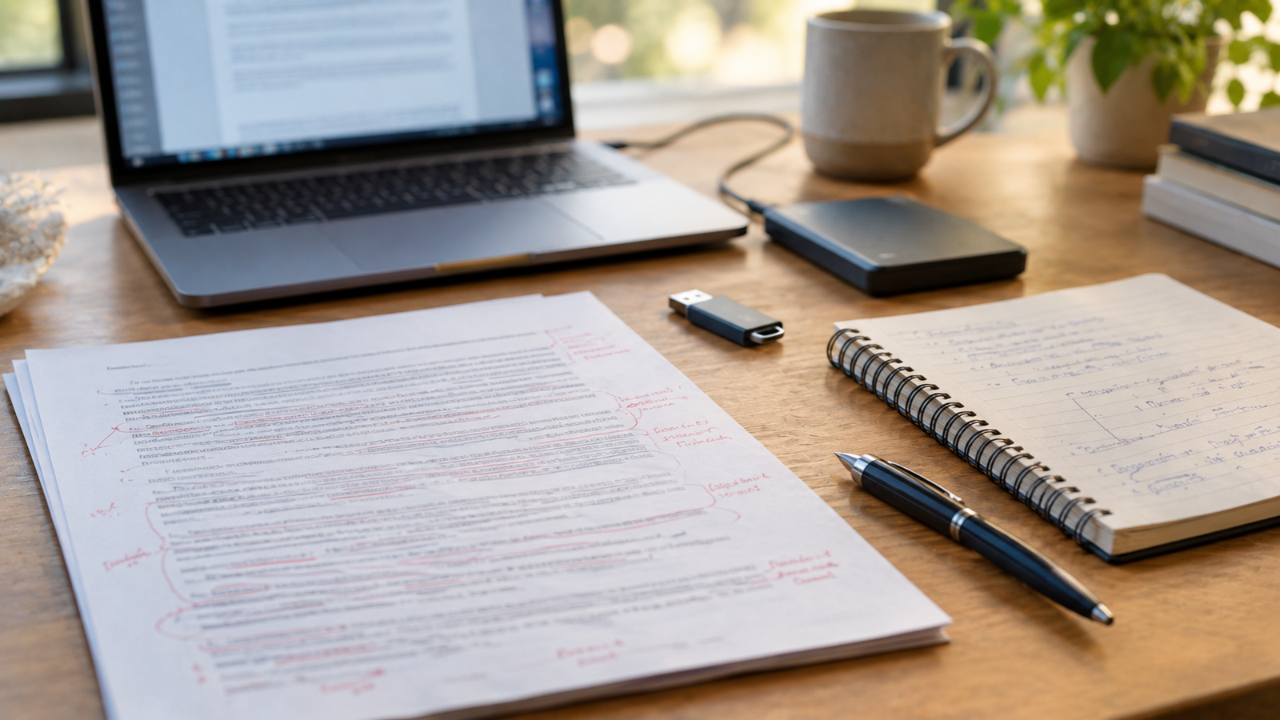
Search methodically: local folders, email attachments, external drives, legitimate backups, learning platforms and accounts you used at the time. Check whether you sent an extract to a tutor or downloaded a copy for printing. Record what you searched and what you found. A short search log can explain the limits of the available material without pretending to be an original writing diary.
Microsoft explains that Microsoft 365 version history depends on files being stored in OneDrive or SharePoint. That illustrates why using Word does not, by itself, guarantee an accessible history. Verify the storage arrangement used for your actual file before claiming that a missing history is either suspicious or technically inevitable.
If recovery requires university IT assistance, make a focused request identifying the account, approximate date and file. Ask whether relevant backups or records can be preserved. Do not promise the investigator that IT can retrieve a deleted file until this has been confirmed. Also avoid installing unfamiliar recovery software on the only device holding potentially relevant evidence without appropriate advice.
Build the account from authentic surrounding records
Drafts are only one possible part of the picture. Relevant records may include reading notes, library enquiries, meeting invitations, supervision emails, handwritten calculations, source annotations or feedback on a proposal. Their significance depends on what they show. An appointment confirms that a meeting was arranged; an email discussing the argument may show considerably more.
For each record, write a brief explanation of the point it supports. A note comparing two studies may connect to a paragraph in the submission. A spreadsheet may show the calculations behind a result. Avoid flooding the university with unrelated study materials simply to make the bundle look substantial. The panel needs a clear route between the evidence and the disputed work.
Be cautious with claims about access records. Downloading an article does not establish that you read it fully or wrote every sentence discussing it. Nevertheless, an accurately dated download alongside annotations and a coherent explanation may be useful. Describe the combination honestly and leave room for the university to evaluate its weight.
Label a present-day reconstruction openly
It can be helpful to prepare a chronology now, using memory and surviving documents. Put the preparation date on it. Distinguish dates confirmed by records from approximate recollections. If you remember drafting over a weekend but cannot identify the exact day, say that rather than supplying a falsely precise timestamp.
Never recreate a rough draft and present it as a recovered original. Do not change file properties, invent handwritten notes or ask someone to confirm an event they did not witness. Those steps would undermine the response and may generate separate concerns. A current explanatory document is legitimate when its status is made clear.
Consider a fictional student who wrote an essay in a single offline file and printed two pages for discussion with a tutor. The original electronic drafts are unavailable, but the annotated printout and tutor email remain. The student can explain how those records relate to the final argument. There is no need to manufacture intermediate versions to make the sequence look continuous.
Explain unusual technical features cautiously
A document created shortly before submission may be a final copy exported from another application. A large pasted section might reflect movement from a separate draft. These are possible explanations, not facts to adopt because they sound helpful. Use the explanation that matches your actual process and identify any supporting records.
If the university draws conclusions from metadata, ask which fields were examined and what inference is being made a disclosure expectation grounded in Public Law. A file date, author field or editing duration should not be treated as self-explanatory. You may need technical advice where interpretation is central, but a specialist should receive the original material and a clear question rather than being asked to endorse a preferred story.
Avoid an unnecessary contest over technical certainty. Your evidence may show a plausible workflow without proving every keystroke. Conversely, missing metadata does not make all other concerns disappear. Address content, sources, assistance and the drafting process together so that the response engages with the whole allegation.
Prepare to discuss the work itself
Read the submitted assignment closely, including its references and limitations. Be ready to explain why you chose the question, how the argument developed and which sources influenced your position. Use the vocabulary you understand. If you discover an error, acknowledge it and explain how it arose as accurately as you can.
Do not confuse preparation with learning a replacement account. Memorising explanations supplied by someone else may leave you unable to answer follow-up questions. If time has passed or illness affects recall, explain that and request suitable meeting arrangements. Check the university’s rules on accompaniment and representation before assuming a parent or adviser can answer for you.
When you cannot remember, distinguish uncertainty from denial. Saying that you do not recall the precise order of two revisions is different from conceding that you did not write the work. A measured answer can preserve both accuracy and your position. Ask for a question to be clarified where you do not understand what evidence it concerns.
Address deadlines and seek focused support
Tell the university promptly if account access or recovery work is delaying the response. Explain what you can provide now, what you have requested and when you expect an answer. Seek a written extension if needed. Continue preparing the available evidence while that request is considered, because a pending request does not necessarily alter the deadline.
Parents can assist by locating old devices, organising correspondence and keeping a record of searches. They should not fill gaps in the student’s memory with assumptions. A simple evidence index, with an honest description of each item, is often more useful than a family narrative that becomes increasingly confident as it is repeated.
Consider what a witness can genuinely add. A housemate may remember seeing you study, while a tutor may recall discussing a particular argument. Those accounts have different evidential value. Ask witnesses to describe events they personally observed, including approximate dates and any limits to recall. Do not ask them to certify that you wrote every word unless they could actually know that. A modest statement about a specific discussion can be more useful than a sweeping character reference, especially where it connects with a surviving document or identifiable part of the submission.
Adam Hussain’s academic misconduct and university appeal work includes examining allegations, records and institutional reasoning. Aldwych Legal can help identify which missing materials matter, explain the limits of surviving evidence and prepare a response grounded in the student’s actual working process.
If your university has requested drafts you cannot produce, send Aldwych Legal the allegation, assessment instructions, final submission and deadline. Call or WhatsApp 020 4584 2472 or email info@aldwychlegal.com. Support is available remotely for students and parents dealing with university proceedings across England and Wales.
About Adam Hussain
Adam Hussain is Aldwych Legal’s Founder & Managing Director and head lawyer. His academic misconduct and university appeal experience includes examining allegations, available records and institutional reasoning. The focus is an accurate explanation of surviving evidence and the student’s actual working process. He holds an LL.M. in International Business Law from King’s College London, has completed Bar training and Practical Legal Training, and is a PhD doctoral researcher in Legal Science at Royal Holloway, University of London.



