

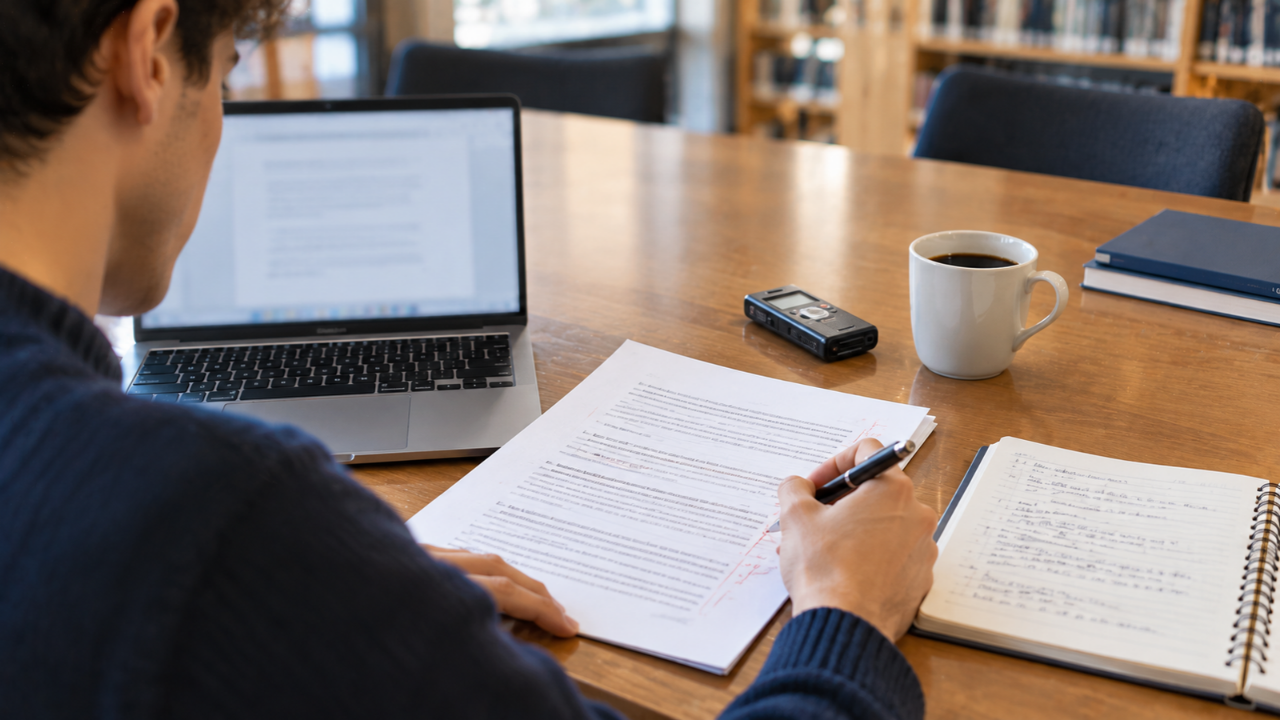
A misconduct interview may last an hour, but a few lines in its written record can influence the rest of the case. If the note says you admitted using an essay service when you described using a dictionary, the discrepancy needs a prompt, evidenced response. Less dramatic errors can also matter: a missing qualification may turn uncertainty into apparent agreement.
The objective is an accurate account of the relevant evidence, not a more flattering version of the conversation. Separate mistakes in recording what you said from answers you now wish you had expressed differently. That distinction central to any effective Dispute Resolution response makes a correction request clearer and protects your credibility if the recording or contemporaneous notes are later checked.
Establish what kind of record you received
Check whether the document is described as minutes, an interview summary, an investigator’s report or a transcript. A summary will not necessarily reproduce every word. Its accuracy should be assessed against its purpose and the conclusions drawn from it, rather than treating every omitted sentence as a procedural defect.
Look for the record-keeping provision in your own procedure. Bristol’s published academic misconduct procedure, for example, provides for interview notes to be circulated afterwards. That does not mean every university uses the same record or checking process. Ask which document will be treated as the interview evidence in your case.
Preserve your own recollection promptly
Write a dated note while the interview is fresh. Record the questions you remember, the answers in dispute, who attended and any breaks or interruptions. Mark passages that are approximate rather than placing uncertain wording inside quotation marks. A candid note of what you remember is more useful than an apparently perfect reconstruction written much later.
If a companion attended, ask them to make their own account independently. Avoid jointly drafting identical recollections and presenting them as separate corroboration. Keep any permitted contemporaneous notes in their original form. Where a university recording exists, request preservation and access through the appropriate route before routine retention arrangements become an issue.
Identify the errors with exact references
Use the document’s paragraph numbers or page and line references. State what the record says, what you believe was said and the evidence supporting the correction. A short schedule often works better than an emotional letter challenging the whole meeting. Give priority to discrepancies relevant to findings, credibility or penalty.
Dates, document names and named people can often be checked objectively. A statement that you “accepted copying” requires closer examination of the question and answer. Perhaps you accepted that text matched but disputed how the match arose. Explain that precise difference and why it affects the alleged misconduct.
Distinguish omission, interpretation and later clarification
An omission might be that the note records “I used an online tool” but excludes your explanation that it was the university’s approved reference manager. An interpretation might be the investigator calling an answer evasive. A later clarification might concern a date you could not remember until checking your calendar.
These need different responses. Request inclusion of the missing explanation, challenge the basis of the interpretation, and label the later information as a clarification supported by a newly checked record. Do not imply that you supplied the calendar detail in the interview if you did not. Accuracy includes acknowledging the limits of your original answer.
Ask for the original context
Where a disputed sentence may depend on the question, ask for the relevant question and surrounding passage. A clipped answer can change meaning when separated from what prompted it. If the record was produced from an audio recording, request the relevant segment or a checked transcription under the institution’s process.
Do not edit an original recording or overwrite the only copy of a document. Work from duplicates and preserve the originals. If you have your own recording, obtain advice about the university’s recording rules and appropriate handling before circulating it, particularly where it contains other people’s personal information.
Make a proportionate correction request
Send your response to the case contact within any stated comments period, or promptly if none is given. Ask whether the note can be corrected, supplemented with your statement or marked as disputed pending verification. Request confirmation that decision-makers will receive the correction alongside the original record.
A university may wish to preserve the historical record of what its investigator originally wrote. In that situation, a clearly linked correction can be more practical than demanding that every earlier version disappear. The essential question is whether future readers can see the dispute, relevant evidence and resolved position without relying on a misleading extract.
Understand the separate data-protection route
The ICO explains that individuals have a Human Rights & Civil Liberties right to seek correction of inaccurate personal data and, in appropriate circumstances, completion of incomplete data. That route can be relevant to a factual interview record. It is not a substitute for using the Education Law disciplinary process to contest the university’s assessment of the evidence.
An accurately recorded opinion may remain disputed without becoming a simple transcription error. If an investigator wrote that they found your answer unconvincing, explain why that assessment is unsound rather than assuming a rectification request must remove it. Where the opinion rests on a demonstrably incorrect fact, identify and evidence that foundation separately.
Respond to a refusal or partial correction
Read the reason carefully. The university may accept a wrong date but consider a disputed admission accurately recorded. Ask what it checked and whether a recording, interviewer note or companion’s account was considered. Concentrate on the unresolved material point rather than reopening corrections already made satisfactorily.
If the university declines to change the record, request that your response remains attached to it and reaches the panel. Ask whether you will be able to explain the dispute orally. Keep the original note, your schedule and the reply together so later reviewers can understand the issue without reconstructing several email chains.
Explain the significance to the decision
A spelling error in an unrelated name may have no practical effect. A statement that you admitted receiving a completed assignment could be decisive. Explain what inference the panel might draw from the disputed entry and how the corrected account changes the issue it must decide.
Avoid overstating the result. Correcting an admission does not necessarily disprove other evidence, such as messages or matched text. Your response should address that evidence too. Conversely, do not accept a serious inaccurate statement simply because the university also has other concerns: each proposition should be assessed on its proper basis.
Protect deadlines and prepare the next stage
A request to amend notes does not automatically extend the deadline for your substantive response or appeal. Check those dates independently. If the record is still disputed, identify that in your submission and explain what verification remains outstanding, while answering the parts of the allegation you can address.
When an outcome relies on the disputed note, link any appeal to the actual reasons. State where the decision treated the note as an admission, what contrary evidence existed and whether your correction reached the panel. That creates a focused challenge to the reasoning rather than a general complaint about the investigator’s manner.
If someone asks you to sign the interview note, find out what the signature confirms. It may acknowledge receipt, confirm accuracy or record that comments were invited. Read the wording and identify unresolved corrections before signing an accuracy declaration. You can acknowledge that a document arrived without agreeing that every sentence is right. Keep a copy of the version you reviewed, since an amended document with the same filename can otherwise make it difficult to establish what was accepted and what remained disputed.
Getting help with the record
Adam Hussain, Aldwych Legal’s principal lawyer, Founder and Managing Director, has experience in academic misconduct and university appeals. The firm can help compare interview records with available evidence, distinguish corrections from new explanations and prepare a concise response that preserves the student’s accurate account.
Email the interview note, allegation letter and comments deadline to info@aldwychlegal.com, or call 020 4584 2472 for assistance in England and Wales. Aldwych Legal provides non-reserved legal services; reserved litigation and advocacy, where needed, are undertaken through appropriately authorised solicitors or counsel.
About Adam Hussain
Adam Hussain is Aldwych Legal’s Founder & Managing Director and principal lawyer. His academic misconduct practice includes analysing interview records and decision reasons, distinguishing factual corrections from later explanations and connecting material errors to the appropriate challenge. He holds an LL.M. in International Business Law from King’s College London, has completed Bar training and Practical Legal Training, and is a PhD doctoral researcher in Legal Science at Royal Holloway, University of London.



