


One wrong click cost our client thousands, and almost his entire pension.
Retirement should feel like the reward at the end of a long career. It shouldn’t come with a surprise tax bill and months of stress.
But that’s exactly what happened to one of our clients, after a regulated financial adviser ignored his clear instructions and cashed in his entire pension.
This case study looks at how Aldwych Legal helped him fight back, and what anyone in a similar position needs to know about professional negligence claims against financial advisers.
Here’s a situation that’s more common than you’d think.
The Client’s Challenge: One Instruction, One Costly Mistake
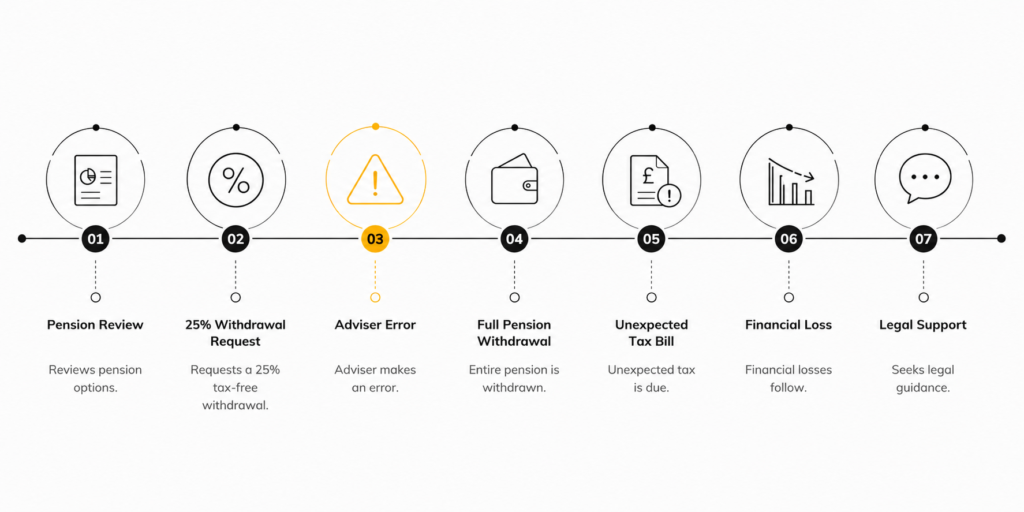
Our client had a pension portfolio managed by a regulated independent financial adviser.
At his annual review meeting, he gave one clear instruction. He wanted to withdraw only his 25% tax-free cash entitlement, the standard, tax-efficient way most people access part of their pension.
That instruction was written down in the adviser’s own meeting notes. There was no ambiguity.
Then the adviser’s team did something very different. Instead of releasing 25%, they liquidated the entire portfolio. Every penny, converted to cash.
The Damage Was Immediate and Irreversible
The client spotted the error within days. By then, it was too late to undo.
Because the whole pension had been cashed in rather than just the tax-free portion, the consequences stacked up quickly. If you’ve ever worried about this happening to you, here’s exactly what went wrong:
- The full amount became liable to income tax, instead of just the 25% he’d asked for
- The resulting tax bill was far higher than anything he’d planned for
- He suffered an investment loss from being forced to sell everything prematurely
- He lost out on the growth those funds would have earned if they’d stayed invested
- He was charged fees connected to the very transaction that caused the problem
When the adviser eventually responded, they admitted there had been “an internal miscommunication.” But their offer only covered a narrow calculation of investment performance.
The tax liability, the biggest part of his loss, wasn’t addressed at all.
Frustrating? It happens more often than it should.
So how does the law actually deal with a mistake like this? Here’s the short version, no law degree required.
Understanding the Legal Issues Behind the Claim
Regulated Advisers Have to Meet Enforceable Standards
The adviser was authorised and regulated by the Financial Conduct Authority (FCA). That status isn’t just a badge. It comes with binding obligations.
Under the FCA’s Principles for Businesses, Principle 2 requires a firm to act with due skill, care and diligence, and Principle 6 requires it to treat customers fairly. The FCA Conduct of Business Sourcebook (COBS 2.1.1R) goes further, requiring firms to act honestly and professionally in their clients’ best interests. These aren’t vague aspirations. A firm can’t quietly set them aside when something goes wrong internally.
Alongside the regulatory position, the case also engaged the common law test for professional negligence from Bolam v Friern Hospital Management Committee, which asks whether a professional acted as a responsible body of their peers would. Here, the adviser’s own correspondence admitted the liquidation was down to an internal miscommunication, which made duty, breach and causation relatively straightforward to establish.
Naturally, the adviser didn’t leave it there. This is the part advisers often lean on, so it’s worth understanding.
The Adviser’s Defence: “You Made It Worse Yourself”
The adviser tried to argue causation had been broken: once the client understood the tax consequences, he chose to proceed with the full withdrawal anyway, and that decision, they said, severed the chain of responsibility.
It’s a common defence tactic. But it doesn’t hold up well under scrutiny.
Applying the scope-of-duty principle from South Australia Asset Management Corp v York Montague Ltd, the real question is whether the loss falls within the scope of the duty the adviser was engaged to protect against.
An adviser instructed to manage withdrawals and their tax consequences can’t create a damaging situation and then blame the client for managing the fallout. The risk that materialised was precisely the risk the adviser was there to prevent.
The Pre-Action Protocol
Before any court proceedings can begin, professional negligence claims are governed by the Pre-Action Protocol for Professional Negligence. It requires a claimant to set out the facts, the legal basis, the heads of loss, and the supporting documents, giving the other side a reasonable period to respond. Getting it wrong can carry real cost consequences later.
This is where we stepped in, and where you’d want someone in your corner too.
How Aldwych Legal Supported the Client
It’s worth being clear about who we are and what we do.
We’re a London-based Law Firm providing legal services to individuals and businesses across the United Kingdom & Qatar, working alongside a trusted network of authorised solicitors and direct-access barristers whenever reserved legal activity, such as issuing court proceedings, becomes necessary.
In this matter, our job was to build the strongest possible case before it ever reached that stage.
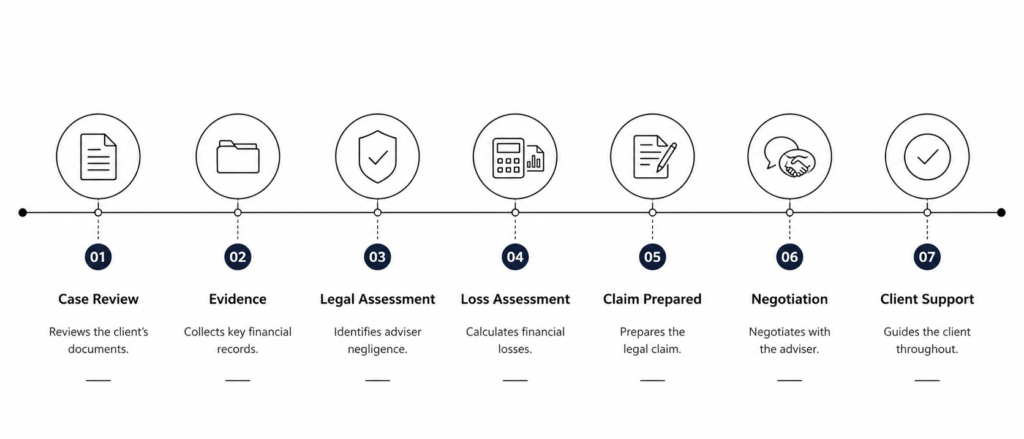
Evidence review. We built a clear chronology from the meeting notes, transaction records, correspondence and the adviser’s own admission of error, exposing the inconsistencies in their position.
Legal and regulatory analysis. We mapped the FCA framework onto the facts, quantified every head of loss, and addressed the causation argument early, rather than waiting for the adviser to raise it.
The letter of claim. We served a formal letter under the Pre-Action Protocol, setting out the facts, legal basis, evidence and remedies sought, requiring a response within three months.
Response, rebuttal, and negotiation. When the adviser’s response arrived, we prepared a written rebuttal with revised figures.
As their position moved from a low offer to a substantially improved one, we advised the client on the merits and risks at each stage. We were always candid that a stronger legal position isn’t the same as a guaranteed outcome.
We also kept the Financial Ombudsman Service (FOS) open as a parallel route. For complaints referred after 1 April 2025, the FOS can award up to £445,000, within six months of the adviser’s final response.
Progress Achieved
When the client first came to Aldwych Legal, the adviser had offered no meaningful redress.
Once our formal pre-action letter landed, that changed. The adviser moved from an offer that ignored the tax issue completely to a substantially improved offer, including a revised investment-loss calculation and a distress payment.
That shift came directly from the legal and evidential work behind it: the documents were marshalled, the causation argument was exposed, and the regulatory framework was applied in a way the adviser couldn’t brush aside.
The client ultimately chose to continue independently before the matter reached its conclusion.
At that point, his legal position was materially stronger than when he started, with a full written analysis of his options, risks and continuing strategy, including the FOS route and the option to escalate to an authorised solicitor or barrister.
If you take nothing else from this case, take these points.
Key Legal Takeaways
- FCA-regulated advisers are bound by enforceable standards. These can’t be waived through internal disclaimers or contractual small print.
- Causation is often the real battleground. The “you made it worse yourself” defence needs to be addressed early and directly, not left as a surprise.
- The Pre-Action Protocol is a genuine tool, not a formality. Proper compliance puts real pressure on the other side before proceedings are ever needed.
- Early evidence review isn’t optional. The strength of a pre-action letter depends entirely on the quality of the analysis behind it.
- FOS and the courts aren’t mutually exclusive. But strict time limits apply to each, so timing matters.
So, what does this mean if you’re in a similar spot right now?
Conclusion: Why Early Advice Changes the Outcome
Professional negligence by a regulated financial adviser can cause serious, lasting financial harm. It should never go unchallenged. The sooner the evidence is reviewed and the right regulatory and legal framework is applied, the stronger a client’s position becomes.
Careful preparation, not just a strongly worded complaint letter, is what shifts an adviser’s response from dismissive to substantive.
How Aldwych Legal Can Help
In financial services disputes and professional negligence matters, we provide evidence review, legal and regulatory analysis, pre-action correspondence, response review and rebuttal, negotiation support, and preparation for referral to the Financial Ombudsman Service, or to our trusted network of authorised solicitors and direct-access barristers where formal proceedings become necessary.
We also support clients through our dispute resolution, commercial litigation, banking and finance, and civil litigation services, wherever the facts of a case call for it.
We work methodically and transparently, explaining your legal position clearly and giving you honest advice on the realistic options and risks at every stage.
If you believe a regulated financial adviser has caused you loss through negligence or a breach of their regulatory obligations, early legal analysis of the evidence is the most important step you can take.
If this sounds familiar, we’re happy to talk it through.
Contact Aldwych Legal at info@aldwychlegal.com or visit www.aldwychlegal.com to discuss your matter.