


Responding to a defamation letter is one of the most stressful things a person can be asked to do — especially when it lands at the worst possible moment.
Political campaigns move fast. Social media moves faster.
So when a professional standing as an independent candidate in a local election received a hand-delivered legal letter, on the morning he was out campaigning, the timing wasn’t an accident. This case study looks at how you go about responding to a defamation letter when it’s designed to hit you at the worst possible moment.
The letter accused him of defamation. It threatened court proceedings. It threatened to report him to the Electoral Commission.
And it demanded he act immediately, or face the consequences.
Here’s what happened next, and what it teaches anyone facing a legal threat that’s designed to pressure rather than persuade.
The Client’s Challenge
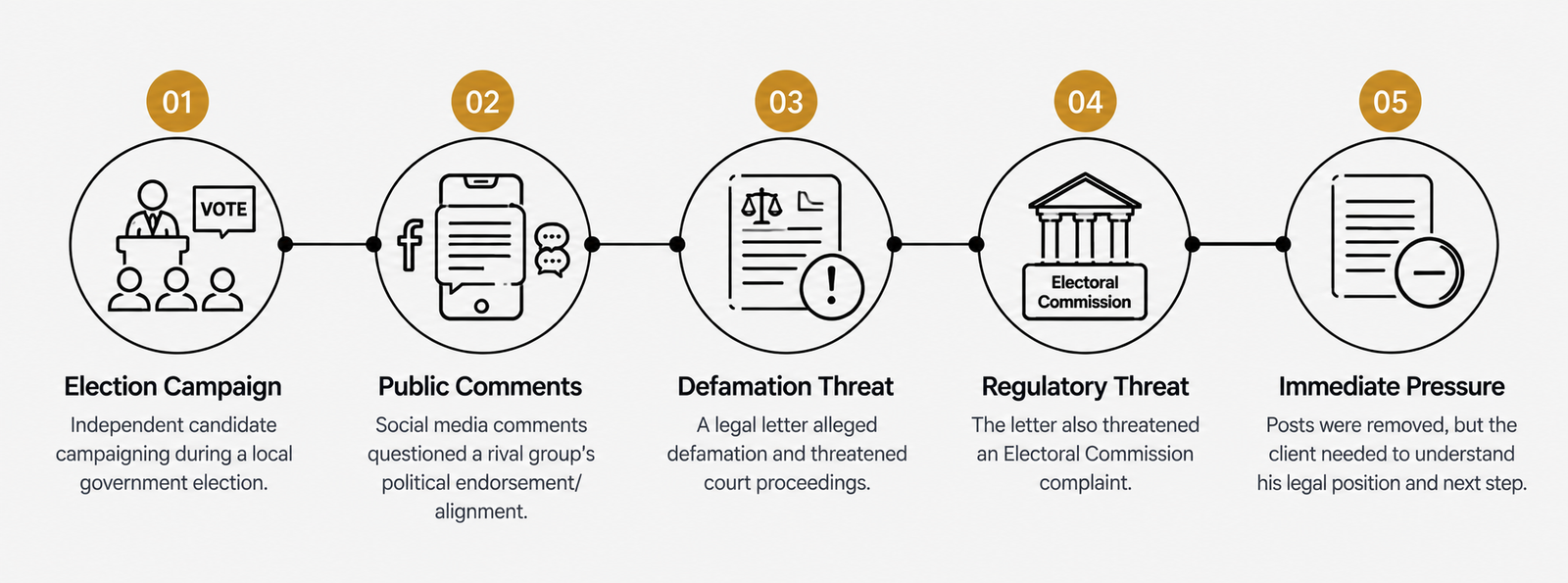
Our client was standing as an independent candidate in a local government election.
During the campaign, he’d made public comments on social media questioning whether a rival group of independent candidates was endorsed by, or aligned with, a national political party. This wasn’t an isolated jab. It was part of a live, public debate already circulating in local community forums, including questions about whether the rival group’s own campaign material had once used the word “endorsed” before quietly being edited.
The rival candidate’s response wasn’t a public rebuttal. It was a formal legal letter.
The letter claimed the comments were defamatory. It said they falsely implied a political connection that didn’t exist. It suggested that repeating the claims could even breach Electoral Commission rules on campaign material.
It demanded:
- Immediate removal of the posts
- A public correction
- Written confirmation of compliance
And it threatened both court proceedings and a regulatory complaint if he didn’t comply.
Understandably, our client took this seriously. He worked in a regulated profession, where even an unproven defamation allegation carries real personal and professional risk. This is exactly the kind of situation where responding to a defamation letter calmly, rather than reactively, matters most.
He’d already taken the posts down before contacting us. His only direct exchange with the other side had been a short email acknowledging receipt. He hadn’t posted anything further, and he hadn’t admitted anything either. What he needed to know was simple: how seriously should he take this, and what should he do next?
Understanding the Legal Issues Before Responding to a Defamation Letter
Two separate legal frameworks were at play here, and it mattered that they weren’t allowed to blur into one another.
1. Was this actually defamation?
Under section 1 of the Defamation Act 2013, a claimant can’t win a defamation case just by saying something felt damaging. They have to show the statement caused, or is likely to cause, serious harm to their reputation.
That’s a genuinely meaningful bar, not a box-ticking formality.
The Act also protects three core defences:
- Truth — the statement was substantially accurate
- Honest opinion — it was a genuinely held view, not a false factual claim
- Public interest — the statement contributed to a matter the public had a legitimate interest in
On the facts here, all three were realistically in play.
2. Did this breach election law?
The letter also raised the Electoral Commission, implying that repeating claims about a rival candidate’s endorsement could break the rules on campaign material.
But the actual law is narrower than that.
Section 106 of the Representation of the People Act 1983 makes it an offence to publish a false statement of fact about a candidate’s personal character or conduct, made specifically to affect the outcome of an election.
Arguing about political alignment, or disputing what “endorsed” actually means, isn’t the same as attacking someone’s personal character. The Electoral Commission’s own guidance confirms there’s a lot of room for candidates to argue about political positioning, precisely because healthy debate is the point of an election.
3. Did the letter even meet the right procedural standard?
There’s a third layer here too.
Where a defamation dispute is heading towards court, the Pre-Action Protocol for Media and Communications Claims sets out what a proper complaint needs to include: the exact words complained of, the specific meaning alleged to be false, and evidence of serious harm.
The letter our client received didn’t get close to that standard.
How Aldwych Legal Supported the Client
We read the letter properly, the same day it arrived
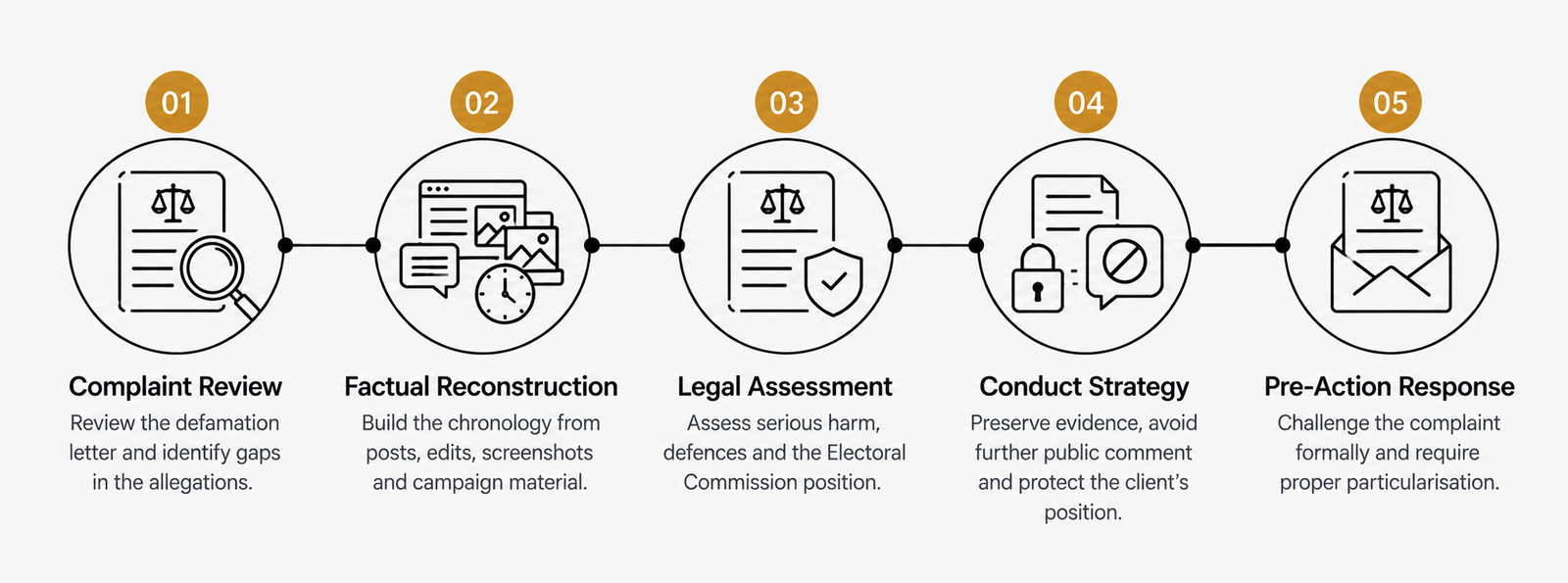
Aldwych Legal reviewed the complaint in full, immediately.
What became clear quickly: for all its confident tone, the letter wasn’t legally particularised. It quoted two snippets from our client’s posts but never explained precisely what defamatory meaning was being alleged, why that meaning was false, or what evidence showed serious harm. The Electoral Commission threat was asserted, not grounded in any specific rule.
We reconstructed the full picture, not just the cherry-picked extracts
We worked through a detailed factual questionnaire with our client to build the complete chronology: the original posts, any edits and their timing, the wider thread context, and the rival group’s own public campaign material.
That included reviewing screenshots showing the rival group had described its own candidates as “fully supported” by a national party, and mapping out the exact sequence of events from the first post through to the legal letter arriving.
The goal was simple: understand the dispute as it actually happened, not as it was selectively presented in the complaint.
We assessed the legal position properly, on both fronts
We looked at whether our client’s comments were genuinely statements of fact, or inference, opinion, and political commentary. We tested whether the serious harm threshold under the Defamation Act 2013 was realistically met. We checked whether truth, honest opinion, and public interest defences applied.
We ran the same rigour over the Electoral Commission angle, testing it against section 106 of the Representation of the People Act 1983 and the Commission’s own published guidance.
Our conclusion: the complaint significantly overstated its legal footing, and the regulatory threat looked more like pressure than a properly grounded legal position.
We advised him on conduct, before anything else could go wrong
While the matter was live, we advised our client to make no further public comment, preserve every screenshot and piece of metadata, avoid unnecessary admissions in any direct contact, and manage any further approach from the other side carefully.
This advice went out fast, before the situation had a chance to escalate further.
We drafted and sent a formal pre-action response
This was the centrepiece of the work, and the clearest example of responding to a defamation letter the right way rather than the reactive way.
We drafted a detailed response letter that put the dispute on a proper legal footing. It:
- Identified exactly where the original complaint fell short
- Required the other side to properly particularise their claim: the precise words, the alleged meaning, why it was false, and the evidence of harm
- Challenged the Electoral Commission threat and asked for the specific legal basis behind it
- Set out our client’s context, including the rival group’s own public campaign language
- Noted, without conceding anything, that our client had removed the posts promptly and responsibly
- Reserved our client’s position in full on every available defence
- Gave the other side seven days to respond substantively
If you’re facing a similar situation, this kind of structured response sits at the heart of what our Defamation Law service is built for.
Our Strategy for Responding to a Defamation Letter
The core decision here wasn’t whether to fight or fold. It was to reframe the whole dispute on legal terms.
A complaint like this, delivered mid-campaign, is designed to create pressure. The implicit message is: comply now, or face proceedings and a regulator at the worst possible moment.
Most people react in one of two ways. Either they panic and comply with everything, or they respond angrily and publicly. Both reactions actually help the other side.
The better move was to strip the complaint back to what it actually contained: an emphatic letter that hadn’t been properly grounded in law. By demanding proper particularisation under the Pre-Action Protocol for Media and Communications Claims, the burden shifted back onto the person making the complaint. If their claim was solid, they’d now have to prove it with precision. If it wasn’t, that would become obvious fast.
At the same time, every part of our response protected our client’s position without conceding an inch. Removing the posts was framed as prompt, responsible conduct, not an admission of guilt. His account of the wider context went firmly on the record. The Electoral Commission threat was challenged head-on rather than politely sidestepped.
This is exactly the kind of situation our Dispute Resolution work is designed for: taking control of a dispute before it escalates into something neither side actually wants.
Progress Achieved: Where the Case Stands Now
Within seven days of the original complaint landing, the situation had gone from an unmanaged legal threat to a properly disciplined pre-action position.
Here’s what that looked like in practice:
- Our client’s legal exposure had been properly assessed
- The complaint had been formally and specifically challenged
- The other side had been put on notice that any next step would need to meet a proper legal standard
- The file was fully prepared for referral to specialist counsel, should things escalate further
As at the time of writing, the matter remains active at the pre-action stage. No admission has been made. No concession has been given. Our client’s position is reserved in full.
Key Legal Takeaways on Responding to a Defamation Letter
If you take one thing from this case study on responding to a defamation letter, make it this: don’t let the tone of the letter dictate your reaction. A few more lessons that apply well beyond politics:
- A confident tone isn’t the same as a strong legal case. Letters can sound formidable and still be legally thin.
- “Serious harm” is a real threshold, not a formality. The Defamation Act 2013 means a claimant has to prove actual reputational damage, not just discomfort.
- Opinion and public interest are genuinely protected. Political and public debate get meaningful legal breathing room.
- Regulatory threats need checking against the actual rule. An Electoral Commission complaint that isn’t grounded in a specific provision doesn’t need to be taken at face value.
- How you respond in the first 24 hours matters enormously. Removing content isn’t an admission. Going quiet isn’t weakness. But responding without a plan can make things worse.
Conclusion
Defamation threats aren’t always what they look like on the surface.
A letter written in confident legal language, delivered at exactly the moment it will do the most damage, can feel far more serious than it actually is. The Defamation Act 2013 sets a genuine bar for serious harm, and the defences available in political and public-interest disputes are real and substantial.
The right approach to responding to a defamation letter isn’t panic, and it isn’t a public fight. It means taking control of the narrative and making the other side justify their position, particularly in politically charged disputes, where a legal threat can become a campaign weapon if it isn’t handled correctly.
How Aldwych Legal Can Help
Aldwych Legal is a London-based legal consultancy providing non-reserved legal services to individuals and businesses across England and Wales.
In reputational and pre-litigation disputes, our work includes:
- Reviewing complaint letters and identifying their legal weaknesses
- Analysing the applicable statutory framework
- Reconstructing the evidential chronology
- Advising on evidence preservation and conduct strategy
- Drafting formal pre-action correspondence that puts the matter on the right legal footing
We don’t conduct reserved legal activities. Where a matter needs court proceedings, advocacy, or other reserved work, we advise clients clearly and, where appropriate, introduce them to an authorised solicitor or barrister from our professional network.
If you’ve received a defamation letter, a cease-and-desist demand, or a threat of regulatory complaint, and you’re not sure how seriously to take it, the right time to get advice is immediately, before you reply, before you delete anything else, and before the other side gets to set the terms of the dispute.
Contact Aldwych Legal at info@aldwychlegal.com or visit www.aldwychlegal.com to arrange an initial discussion.
Frequently Asked Questions
How do you respond to a defamation letter?
Start by not panicking and not complying automatically. A defamation complaint letter isn’t a court order, and receiving one doesn’t mean the claim is well-founded. Under the Defamation Act 2013, a claimant has to show the statement caused, or is likely to cause, serious harm to reputation. Many pre-action letters fall short of the standard set by the Pre-Action Protocol for Media and Communications Claims, which requires the complainant to specify the exact words, the alleged meaning, and the evidence of harm. Get advice before you respond, and before you remove or change anything.
Can political comments on social media count as defamation?
They can, but it’s more nuanced than most people assume. Opinion, political inference, and commentary on matters of public interest all carry significant legal protection under the Defamation Act 2013. The honest opinion and public interest defences exist specifically to protect robust political debate. Whether a comment crosses into actionable defamation depends on the exact wording, the context, and whether serious harm can actually be shown. Every case comes down to its own facts.
What role does the Electoral Commission actually play in disputes over campaign statements?
The Electoral Commission regulates elections and campaign finance, but its involvement in disputes about what candidates say is more limited than people often think. Section 106 of the Representation of the People Act 1983 targets false statements of fact about a candidate’s personal character or conduct, made to affect an election result. That’s narrower than a general argument about political alignment or what “endorsed” means. A threat to report someone to the Electoral Commission should be checked against that specific provision, not accepted as automatically serious.