


Sometimes doing the right thing doesn’t pay off.
That’s what happened to one of our clients. He was a long-serving public servant caught up in an emergency evacuation. He had insured himself properly.
He had followed every rule.
But when the compensation scheme was finally worked out, he ended up worse off than colleagues who hadn’t insured at all.
This article explains how Aldwych Legal helped him challenge that outcome using public law. It also explains what your own options might be if a government department has treated you unfairly.
(This case is still ongoing. So we’re sharing it as a legal insight, not a finished case study.)
The Client’s Challenge: Doing Everything Right, and Still Losing Out
Our client worked overseas as a senior public servant. He lived there with his family.
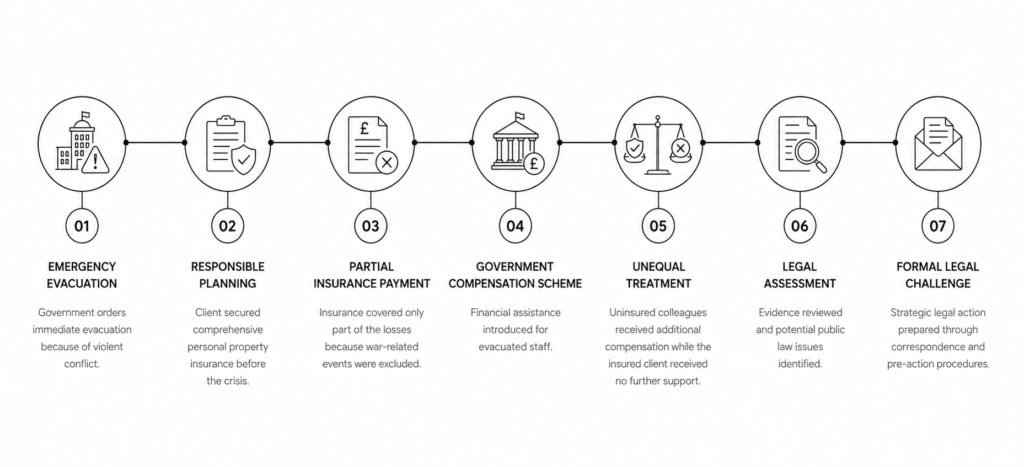
Then things changed fast. A violent conflict broke out in the country where he was based. His employer ordered an emergency evacuation of all diplomatic staff and their families.
There was no time to prepare. Staff could only take the essentials. Everything else was left behind — years of belongings, gone in a single day.
He Had Planned Ahead
Before any of this happened, our client had done the sensible thing. He’d taken out comprehensive personal property insurance. He’d increased his cover to the highest level his employer allowed.
When he made his claim, the insurer paid out. But only up to the policy maximum, and only on an ex gratia basis, since war-related events were excluded from cover. His real loss was much higher than that. So he was left with a serious shortfall that nothing covered.
Then the Compensation Scheme Made It Worse
His employer, a government department, worked with HM Treasury to set up a compensation scheme for the evacuated staff.
Here’s the problem. The scheme topped up staff who had little or no insurance, bringing them up to the same level our client’s insurance had already reached.
Our client, who had insured responsibly, got nothing more.
Colleagues who hadn’t bothered to insure ended up in the same position as him. He was left to cover the rest of his loss on his own.
He spent almost two years trying to get answers. He raised it internally. He asked the department to explain its reasoning. He never got a proper answer.
That’s when he came to Aldwych Legal.
Understanding the Legal Issues
The core question was simple to ask, but hard to answer: can a public body run a compensation scheme that treats similar people so differently, and get away with it?
Was the Decision Irrational?
In public law, there’s a concept called irrationality. It’s also known as Wednesbury unreasonableness.
In plain terms, it means this: a public body’s decision must not be so unreasonable that no sensible decision-maker could have made it.
A scheme that punishes people for insuring responsibly, while rewarding people who didn’t, sits very uncomfortably with that idea.
Did He Have a Legitimate Expectation of Fair Treatment?
There’s also a principle called legitimate expectation.
If a public body’s own behaviour leads you to expect fair and consistent treatment, and it then changes course without a good reason, the courts can step in.
What About Equal Treatment?
This is where the department’s own actions worked against it.
It had already admitted that it corrected an unfair outcome for one group of staff. So the real question became simple: why wouldn’t it do the same for our client, who suffered a similar loss from the exact same event?
The Procedural Battle: Was the Claim Out of Time?
Before any of this could even be argued properly, there was a procedural hurdle to clear first.
Under the Pre-Action Protocol for Judicial Review (part of CPR Part 54), you have to formally notify a public body before starting proceedings. This gives them a chance to explain themselves or resolve the issue.
Judicial review also comes with a strict three-month time limit. The department leaned hard on this, arguing our client’s claim was already out of time.
We disagreed. We identified that the real starting point was later than the department claimed — the date the compensation scheme was finalised, and our client’s exclusion from it became final and clear.
We also kept a second option open: a private law claim. This type of claim has a much longer limitation period of six years, under the Limitation Act 1980. This kind of work sits within our Public Law and Civil Law teams.
How Aldwych Legal Supported the Client
Aldwych Legal is a law firm in London that advises private clients, businesses, and institutions across the United Kingdom and internationally. We deliver decisive, commercially focused legal advice through experienced lawyers, solicitors, and barristers from our professional network who work together across disciplines.
Our guidance is strategic, practical, and designed to protect client interests while moving matters forward with clarity and confidence
Here’s exactly what we did for our client.
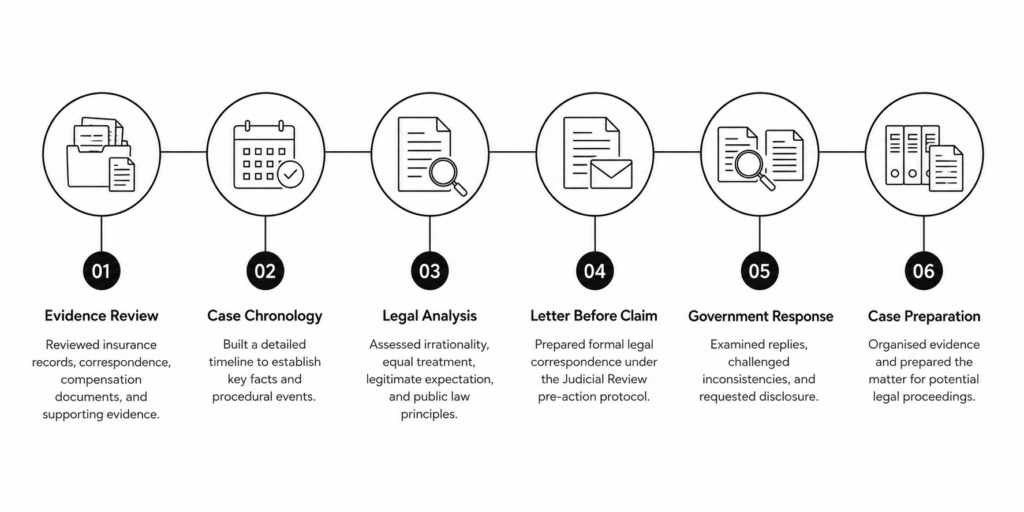
We Pieced the Whole Story Together
We reviewed everything. The insurance policy and settlement letters. The full list and value of his lost belongings. Internal department emails about the compensation scheme. Correspondence with HM Treasury. And our client’s own notes from trying to resolve this himself.
From all of this, we built a detailed chronology — a clear timeline showing exactly when the shortfall became known, when the scheme was finalised, and when his exclusion from it became obvious.
That chronology mattered a lot. It’s what let us push back firmly against the department’s “out of time” argument.
We Built a Strong Legal Case
We checked the compensation scheme against the key public law principles: rationality, proportionality, equal treatment, and legitimate expectation.
One weakness stood out straight away. The department’s own letters admitted the scheme was meant to correct unfairness for one group of staff. Yet it refused to apply that same logic to our client.
We set out all the legal options in written advice. We weighed the risks and benefits of each. Our strategy focused on getting a fair result without unnecessary delay or cost.
We Sent a Formal Letter Before Claim
We drafted and sent a detailed Letter Before Claim. This followed the Pre-Action Protocol for Judicial Review and the Civil Procedure Rules.
It covered:
- The full background of what happened
- The legal basis for the claim
- A clear comparison of how different staff had been treated
- A demand for the shortfall, plus interest and costs
- A request for any internal documents behind the department’s decision
- An offer to resolve things through alternative dispute resolution
We Kept Pushing Back
The Government Legal Department, representing the Secretary of State, replied several times. Their view: the judicial review claim was doomed on timing grounds, there was no private law claim available, and the scheme had been applied lawfully.
We didn’t accept that. We went through each reply carefully, found the weak points and factual errors, and sent a series of firm rebuttal letters.
These letters corrected the department’s version of events, challenged how it framed the legal issues, and kept demanding the internal documents it still hadn’t handed over.
We Got the Matter Ready to Escalate
When the pre-action stage ended without a resolution, we prepared for the next step.
We organised all the correspondence to clearly show our client had engaged fully and reasonably the whole time. And that the department had every chance to sort this out.
We then wrote formally to the Government Legal Department. We flagged that they hadn’t responded to our latest letter, and asked them to confirm they were ready to accept service of legal documents.
Our Strategy: Careful, Not Rushed
We didn’t rush toward court. We built pressure step by step, using three deliberate moves.
1. We reframed what the scheme actually was.
The department’s position was that this was just administrative discretion — a decision they were free to make however they liked. Our analysis showed something different. Once the department chose to top up one group of staff to a common level, the scheme became something more than simple insurance. It became a broader compensation scheme. That shift made it much harder for the department to justify leaving our client out.
2. We kept more than one legal option open.
The department relied heavily on the three-month judicial review time limit. We argued the real starting point was later than they claimed. We also kept a private law claim in reserve. This meant they couldn’t shut down the case on a technicality alone.
3. We kept asking for disclosure.
The department never handed over the internal documents that would explain how it decided to treat different staff groups differently. We kept asking. We made clear that continuing to withhold them could count against the department on costs, if the matter reached court.
Throughout, every letter was written to show our client was being fair and reasonable. But it also made clear the issue wasn’t going to disappear.
Progress Achieved: Where the Case Stands Now
This case is still active. No settlement has been reached, and no court proceedings have started yet.
Even so, the pre-action stage has already achieved a lot:
- The legal and factual issues are clearly written down and on record
- The department has effectively admitted key facts — the forced evacuation, the size of the loss, the insurance cap, and that it corrected unfairness for other staff
- Our chronology has held up firmly against the department’s timing argument
- A long, well-documented paper trail shows we followed the pre-action protocol properly
The Government Legal Department has now been formally told that legal documents may be served soon. If the case does go to proceedings, it will be handled by an appropriately authorised solicitor or barrister. Aldwych Legal will keep providing advisory and strategic support throughout.
Key Legal Takeaways
- Public bodies must make decisions that are rational, proportionate, and consistent — not just convenient for them
- A scheme that treats similar people very differently can be challenged using public law principles like irrationality and legitimate expectation
- Judicial review has a strict three-month time limit, but the actual “start date” isn’t always what you’d assume — it’s worth getting checked properly
- A private law claim can sometimes run alongside judicial review, or replace it, with a much longer six-year time limit
- A clear, well-built chronology can make or break a case, especially when timing is disputed
- Staying persistent matters — steady, well-evidenced letters build real pressure on public bodies, even before court proceedings start
Conclusion: Silence From a Department Isn’t the End of the Road
This case shows a pattern that comes up more often than it should. A public body sets up a scheme to fix one unfair situation. But in doing so, it creates a new unfair situation for someone else.
The people caught in the middle are often the ones who did everything right. They planned ahead. They followed the rules. They acted in good faith. And somehow, the system ended up rewarding the people who didn’t.
If you’re in a similar position, remember this: a government department refusing to engage isn’t the final word. Public bodies operate under legal rules that private individuals don’t. When they fail to meet those standards, there are proper legal routes to challenge them.
But those routes take careful preparation. You need a clear grip on the legal framework, and the discipline to build a record that holds up to scrutiny.
Getting advice early matters more than people think. A well-built chronology, properly kept evidence, and clearly framed legal issues can be the difference between a claim that succeeds and one that fails on a technicality.
How Aldwych Legal Can Help
Aldwych Legal provides legal analysis, evidence review, written advice, pre-action correspondence, and strategic support for individuals and businesses in dispute with public bodies, government departments, and large institutions.
We review your full paperwork, spot the legal and evidential pressure points, and build a strategy that matches what’s at stake. We draft pre-action correspondence that puts the other side on formal notice, protects your legal position, and builds a record that supports escalation later, if needed.
Where a matter needs reserved legal work, such as issuing or running court proceedings, we work alongside appropriately authorised solicitors and barristers. This means the move from pre-litigation to litigation is handled carefully, and none of the work already done goes to waste. Depending on the details, this kind of dispute often connects with our Public Law, Civil Law, and Dispute Resolution teams.
If you’re facing an unfair decision from a public body, a government department, or a large institution, and you’re not sure where to turn, we’re happy to talk it through in a confidential initial consultation.
Contact Aldwych Legal today. Email info@aldwychlegal.com or visit www.aldwychlegal.com.
Frequently Asked Questions
Can I challenge a government department’s decision about compensation?
In many cases, yes. Government departments are public bodies. That means their decisions must be rational, proportionate, and consistent. If a compensation scheme leads to clearly unfair outcomes, or the decision-making process itself was flawed, you may have grounds for a formal legal challenge. The right route depends on your specific facts and timing. Because judicial review has strict time limits, getting advice early really does matter.
What is a Letter Before Claim and why does it matter?
A Letter Before Claim is a formal notice sent before legal proceedings start. In disputes involving public bodies, it’s usually required under the relevant pre-action protocol in the Civil Procedure Rules. It sets out the facts, the legal basis for your claim, and what you’re asking for. This gives the other side a real chance to resolve things before court gets involved. It also creates a clear, formal record of your position, which matters if the case ends up going further.
What’s the difference between judicial review and a private law claim against a public body?
Judicial review is heard in the Administrative Court. It looks at whether a public body’s decision or action was lawful. It comes with a strict three-month time limit, and it can’t be used purely to claim money. A private law claim, such as one for breach of duty or restitution, goes through the ordinary civil courts. It has a much longer time limit, generally six years, under the Limitation Act 1980. In some disputes, both routes are available. Which one you choose can make a real difference to your chances of success. Getting advice on the right route early is important.