


Facing a workmanship claim against your business is one of the most stressful things a small business owner can deal with. One disputed contract is sometimes all it takes to threaten everything you’ve built.
When a trade client brought a County Court claim against a small automotive refinishing business, alleging defective work worth almost £10,000, the temptation was to just pay up and move on.
The problem? The work had been done properly. And paying up would have meant accepting a claim that didn’t hold up.
Here’s how Aldwych Legal helped this business fight back — and what it means if you ever find yourself in a similar position.
(This matter is still ongoing, so we’re sharing it as a legal insight rather than a finished case study.)
The Client’s Challenge: A Claim, and Then a Reputation Attack
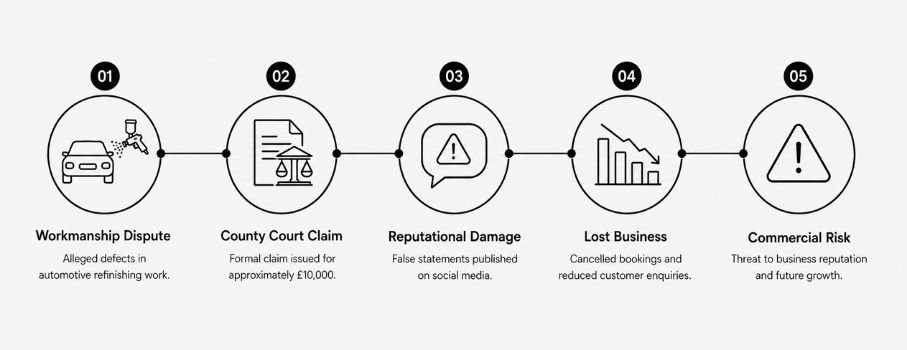
Our client ran a specialist automotive refinishing business. They’d carried out paint and refinishing work on two vehicles for a commercial customer.
When the customer raised complaints, our client did exactly what you’d hope a responsible business would do. They responded quickly. They offered to fix the issues. They stayed engaged and constructive.
None of that stopped what happened next.
The Claim Arrives
A formal Letter Before Action landed. Then, not long after, County Court proceedings followed.
The claim alleged several defects across both vehicles:
- Inadequate paint coverage
- Contamination
- Masking failures
- Component damage
- A noticeable colour mismatch on one vehicle
The claimant valued the claim just below the Small Claims Track threshold. That’s a deliberate move — it keeps costs exposure lower for both sides, but it also limits the legal tools available to argue the case properly.
Then Things Got Worse
While the legal dispute was unfolding, something else started happening. False, damaging statements about the business began appearing on social media and in online communities its customers used regularly.
New bookings started dropping. Customers who’d already agreed to work began pulling out.
This wasn’t a coincidence. It was directly connected to the ongoing dispute — and it was hurting the business in a way that was measurable.
Understanding the Legal Issues Behind a Workmanship Claim
This case actually involved two separate legal battles running side by side: defending the workmanship claim, and deciding whether to fight back against the reputational damage.
What the Law Says When You’re Defending a Workmanship Claim
The claim relied on section 13 of the Supply of Goods and Services Act 1982. This section automatically builds a term into every service contract: the work has to be carried out with reasonable care and skill.
Here’s the key point most people don’t realise: the test isn’t perfection. It’s whether the standard of work matched what a reasonably competent professional in that field would deliver.
And crucially, it’s the claimant who has to prove the breach — not the business defending itself.
That single fact shaped the entire defence. It wasn’t enough for the claimant to simply point at imperfections. They needed to show:
- The work fell below what a competent professional would deliver
- Those specific issues were actually caused by our client’s work — not pre-existing damage or someone else’s involvement
- The losses claimed genuinely resulted from a proven breach
Could the Business Fight the Reputational Damage?
This is where things got more technical.
To bring a claim for defamatory statements, a business generally has to show serious financial loss, or a likely risk of it — a threshold set out in section 1(2) of the Defamation Act 2013.
There’s also an important distinction to understand here. Defamation, malicious falsehood, and harassment are three different legal claims. Each one has different requirements, and courts won’t accept vague, unspecific allegations for any of them.
A Procedural Curveball: The Strike-Out Application
Partway through, the claimant applied under CPR 3.4 to strike out the counterclaim entirely. Their argument: it added unnecessary complexity to what should have been a straightforward small claim.
A strike-out application doesn’t automatically succeed. But it does need to be taken seriously and responded to properly — which is exactly what happened next.
How Aldwych Legal Supported the Client Through the Workmanship Claim
Aldwych Legal is a London-based Law firm that advises private clients, businesses, and institutions across the UK and internationally. We provide strategic, commercially focused legal support in areas including business law, commercial contracts, dispute resolution, construction disputes, employment, property, and regulatory matters.
For matters requiring reserved legal representation, we coordinate seamlessly with appropriately authorised legal professionals while ensuring every case is thoroughly prepared and managed to the highest professional standard.
We Reconstructed the Full Picture
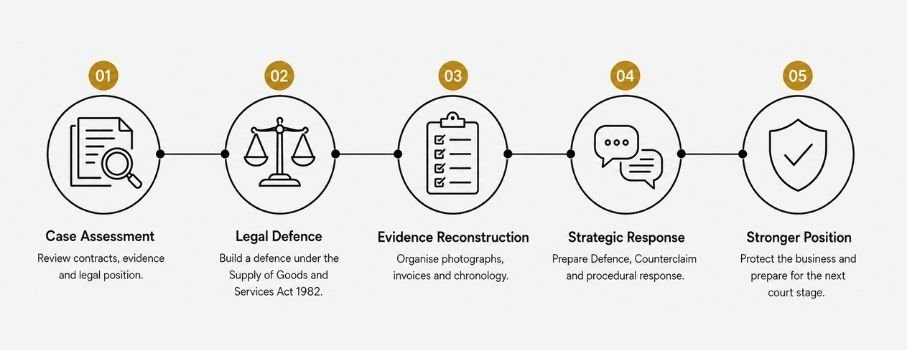
We reviewed everything: job sheets, emails, WhatsApp messages, invoices, and photographs taken before, during, and after the work — plus any sign-off records from when the vehicles were collected.
From there, we built a detailed chronology. Every stage was mapped: the work itself, the handover, the complaints, the rectification period, and the eventual escalation.
This wasn’t a quick summary. It was a forensic reconstruction — built specifically to show where the claimant’s case was strong, where it was weak, and where the evidence backed our client.
We Built the Legal Defence
We analysed the contract in detail against the requirements of the Supply of Goods and Services Act 1982, and mapped the facts against exactly what the claimant would need to prove.
Several weaknesses in the claimant’s case became clear:
- No objection was raised at the point of handover
- The claimant hadn’t engaged with reasonable offers of further rectification
- Some of the losses claimed looked like unrecoverable betterment (essentially, claiming for something better than what was originally there)
- The claimant was relying on expert evidence that hadn’t yet been disclosed for scrutiny
We set all of this out in written advice, along with the risks and requirements involved in pursuing a counterclaim.
We Prepared the Defence, Counterclaim, and Witness Statements
We drafted a detailed Defence addressing every allegation individually — putting forward our client’s positive case on workmanship and acceptance, challenging causation and the amount claimed, and raising the claimant’s failure to properly mitigate their losses.
We also prepared a Counterclaim, built around the reputational harm our client had suffered — supported by the specific conduct alleged, evidence of lost business, and the financial impact.
Every document was prepared to the standard required under the Civil Procedure Rules, and served within the required deadlines. This kind of structured litigation support sits within our Civil Law, Commercial Litigation and Dispute Resolution work.
We Responded to the Strike-Out Application
When the claimant’s N244 application to strike out the counterclaim landed, we analysed it in detail, advised our client on what it meant procedurally, and prepared a considered response.
Our Strategy: Fight Properly, Not Just Loudly
The core strategic decision here was simple to state, harder to execute well: contest the claim properly, rather than settling early from a position of weakness.
The evidence supported that decision. Our client had responded promptly to every complaint, offered genuine rectification, and had contemporaneous records proving the standard of work delivered.
Two Pressure Points at the Heart of the Defence
1. The claimant’s failure to mitigate.
After the rectification period, the claimant simply stopped engaging further. That mattered — a claimant has a duty to take reasonable steps to reduce their own losses, and refusing further reasonable engagement can undermine that.
2. The expert evidence.
Given the age and prior condition of the vehicles, we identified a real risk that the expert evidence being relied on wouldn’t hold up under scrutiny. Both points went directly to causation and quantum, and were built into the Defence from the start.
A Careful Approach to the Counterclaim
On the reputational side, we were deliberate and cautious.
We clearly separated defamation, malicious falsehood, and harassment, and advised our client on what each would require as evidence.
The counterclaim was built around the strongest available material:
- Screenshots of the actual publications
- Records of cancelled bookings
- Financial data showing a real, measurable drop in turnover
At the same time, our client was advised to stay realistic. An under-evidenced counterclaim risks distracting from the primary defence rather than strengthening the overall position.
We also documented and preserved a separate but relevant thread — anonymous calls traced back to the other side, and a threatening remark made directly to Aldwych Legal. Both were kept as potentially relevant evidential material.
Progress Achieved: Where the Case Stands Now
This matter remains active.
Here’s what’s already been achieved:
- The Defence and Counterclaim have both been filed within the required deadlines, backed by a comprehensive body of evidence
- The claimant’s strike-out application against the counterclaim is a live procedural issue currently before the court
- Our client’s legal position has been clearly set out and placed formally before the court
- Weaknesses in the claimant’s case — on causation, quantum, mitigation, and the admissibility of the expert evidence — have all been identified and formally raised
- Our client has been advised on the strategic options at every stage, including the possibility of alternative dispute resolution if a realistic settlement emerges
- The matter is fully prepared for its next procedural stage, with all evidence organised and preserved
Key Legal Takeaways
- If your business faces a workmanship claim for allegedly defective work, the claimant has to prove the breach — you don’t have to prove your innocence
- The legal standard isn’t perfection. It’s whether the work matches what a reasonably competent professional would deliver
- A claimant’s failure to properly engage with rectification offers can significantly weaken their own case
- Bringing a counterclaim for reputational harm is possible, but the evidential bar is high — serious financial loss (or the real risk of it) generally has to be shown
- Defamation, malicious falsehood, and harassment are legally distinct — mixing them up, or pleading them vaguely, weakens your position
- A strike-out application doesn’t automatically succeed — a well-evidenced, properly pleaded counterclaim has a real chance of surviving one
- Deadlines for responding to a County Court claim are fixed. Missing one can have serious consequences, so early advice matters
Conclusion: Don’t Assume You Have to Pay Up
When a workmanship claim lands on your desk in the form of a County Court claim, the instinct is often to either cave in or react emotionally. Neither approach tends to serve a business well.
What actually works is methodical: an early, careful review of the evidence, a clear understanding of the legal framework that applies, and a response that’s proportionate, well-evidenced, and procedurally sound.
This case also highlights something increasingly common in commercial disputes. The contractual claim and the reputational damage often run in parallel — and each needs a completely different legal approach. Mixing the two up, or pursuing a reputational claim without solid evidence behind it, can weaken what might otherwise be a strong defence.
How Aldwych Legal Can Help
Aldwych Legal provides legal analysis, evidence review, written advice, document preparation, and pre-action and procedural support to individuals and businesses facing commercial disputes.
We work methodically through the evidence, identify the legal and factual pressure points, and prepare a response grounded in the law and backed by the documents. Where a matter requires reserved legal work — such as the conduct of litigation before a court — we coordinate with appropriately authorised solicitors or barristers, and ensure the file is prepared to the standard they need to act effectively. This kind of support typically draws on our Civil Law, Commercial Litigation, and Dispute Resolution expertise.
If your business has received a Letter Before Action or a County Court claim, or you’re dealing with a dispute that involves both contractual and reputational dimensions, early advice is almost always more valuable than a late response.
Contact Aldwych Legal today. Visit us at 128 City Road, London, EC1V 2NX, or head to www.aldwychlegal.com to discuss your matter.
Frequently Asked Questions
If someone brings a County Court claim against my business for defective work, do I have to pay even if I believe the work was done properly?
No. You’re entitled to defend the claim. The burden of proving breach, causation, and loss rests with the claimant, not you. A well-evidenced defence that properly challenges the factual and legal basis of the claim can significantly affect the outcome. Early legal analysis is important, because the deadline for responding to a County Court claim is fixed — and missing it can have serious consequences.
Can I bring a counterclaim for damage to my business’s reputation if the other side has been making negative statements about me online?
It may be possible, but the legal requirements are demanding. A business bringing a defamation claim generally has to show serious financial loss, or a likelihood of it. The specific statements complained of need to be identified, their falsity established, and a clear causal link shown between the statements and the financial loss. The distinction between defamation, malicious falsehood, and harassment also matters, since each has different legal ingredients. Getting advice before pursuing a reputational counterclaim is strongly recommended.
What does it mean if the other side applies to strike out my counterclaim?
A strike-out application under CPR 3.4 asks the court to dismiss a claim or counterclaim — usually on the basis that it discloses no reasonable grounds, is an abuse of process, or isn’t suitable for the current proceedings. It doesn’t automatically succeed. The court considers it on its merits, and a well-pleaded counterclaim, properly supported by evidence and particulars, has a reasonable prospect of surviving the challenge. Legal advice on how to respond should be sought promptly.