


You own 15% of a company you helped build. Then, slowly, you’re pushed out of every decision that shapes it.
That’s exactly the position one of our clients found himself in — a minority shareholder in a UK technology company, watching the governance structures meant to protect him get quietly dismantled.
This article looks at how Aldwych Legal helped him fight back, and what it means if you’re facing a similar minority shareholder dispute of your own.
(This matter is still ongoing, so we’re sharing it as a legal insight rather than a finished case study.)
The Client’s Challenge: Built On Trust, Undone By Governance Failures
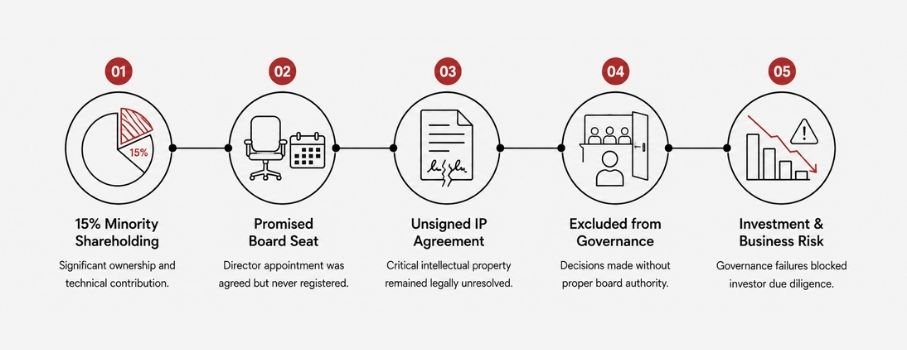
Our client held a 15% stake in a technology company set up as what the law calls a quasi-partnership — a business built on shared participation, mutual trust, and collaborative decision-making between a small group of people who knew each other personally.
He wasn’t a passive investor. He’d contributed substantial technical development work, including building the company’s core operational platforms, often at a significant discount to what that work would normally cost.
The Governance Started Slipping
Things began to unravel over the course of roughly a year.
A promised director appointment never materialised. A board meeting in early 2025 produced a clear, minuted commitment to appoint him as a director. Nearly a year later, it still hadn’t been registered at Companies House.
A critical IP agreement was left unsigned. A successor intellectual property agreement was drafted and acknowledged by one of the other directors. It was never executed. That left the company’s most commercially important systems in legal limbo, blocking a committed round of external investment.
He was frozen out, then targeted. Two majority-aligned directors approached a key commercial counterparty without board authority. They also demanded privileged communications and personal working files from an external legal consultant, falsely invoking board authority to do so.
A legal threat built on a clause that no longer worked. Solicitors were eventually instructed to send formal legal demands. They relied on a clause in the shareholders’ agreement whose operative definition had been removed before the agreement was even signed.
Why the Stakes Were So High
The company was in active talks with external investors. But without a properly executed IP agreement, due diligence simply couldn’t be completed.
Our client had done everything right: he’d built the technology, been promised a board seat, and invested capital on the understanding that governance would be handled properly. All of that was now being actively undermined.
He’d already put together an extensive pre-action pack himself, including a without-prejudice settlement letter and a detailed particulars document running to around 28,000 words. What he needed wasn’t someone to draft more paperwork — he needed a specialist legal mind to pressure-test the case and work out how to deploy it effectively.
Understanding the Legal Issues in a Minority Shareholder Dispute
This matter touched several distinct areas of company law, all interconnected — and together, they show how quickly a minority shareholder dispute can escalate once trust breaks down.
Unfair Prejudice: The Core of the Claim
The central legal framework here is section 994 of the Companies Act 2006. It allows a company member to petition the court where the company’s affairs are being run in a way that’s unfairly prejudicial to their interests.
The court’s powers under section 996 are deliberately wide. It can:
- Regulate how the company conducts its affairs going forward
- Require (or prevent) specific acts
- Order the purchase of a shareholder’s shares
Why “Quasi-Partnership” Status Matters
In a quasi-partnership company — a concept shaped by case law, including the landmark case of O’Neill v Phillips — the court doesn’t just look at the strict wording of the company’s constitutional documents.
It looks at the legitimate expectations created by mutual trust and participation between the people who founded the business.
Someone who was promised a board seat, who built the company’s core technology, and who joined a shareholders’ agreement built on collaborative governance has legitimate expectations that go beyond their formal legal rights on paper. When those expectations are systematically frustrated, that’s exactly the situation section 994 exists to address.
Directors’ Duties Under the Companies Act
Sections 171 to 175 of the Companies Act 2006 set out statutory duties every director owes. Directors must:
- Act within their powers
- Promote the success of the company in good faith
- Exercise independent judgment
- Avoid conflicts of interest
Instructing solicitors without board authority, approaching a commercial counterparty without board sanction, and relying on a clause whose removal one of the directors had themselves recommended — all of this engaged these duties directly.
The Data and Privacy Angle
The demands for privileged communications and personal working files raised a completely separate legal problem.
A director’s common-law right to inspect company books and records, established in Conway v Petronius, doesn’t extend to the private files or privileged advice of an external consultant. Those materials belong to the consultant — not the company.
The demands also had no lawful basis under Article 6 of the UK GDPR for sharing that personal data, and their sheer breadth — covering an entire contractual relationship — couldn’t meet the proportionality standard set out by the European Court of Human Rights in Bărbulescu v Romania, given effect in UK law through the Human Rights Act 1998 and the Data Protection Act 2018.
A Clause That No Longer Meant Anything
One final wrinkle: the shareholders’ agreement contained a clause granting information rights to a defined category of shareholder. But the definition of that category had been removed before the agreement was signed — following a tracked-change comment recommending its removal, made by one of the same directors now trying to rely on it.
In other words, the clause being used to threaten legal action no longer had any operative meaning at all.
How Aldwych Legal Supported the Client
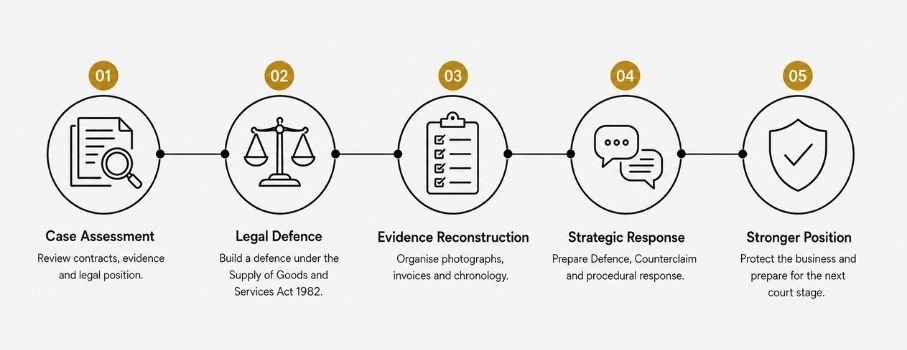
Quick but important clarification: Aldwych Legal is not a firm of solicitors.
We’re a London-based legal consultancy providing non-reserved legal services. Where reserved legal work is needed — such as filing a formal petition — we work alongside our trusted network of appropriately authorised solicitors and barristers.
Here’s what we actually did.
We Pressure-Tested the Entire Case
Our client arrived with a comprehensive pre-action pack already prepared: a without-prejudice settlement letter and a detailed particulars document setting out eleven separate grounds of unfair prejudice.
We read the full evidential record and stress-tested each ground against the applicable legal framework. We assessed the admissibility and weight of the evidence, including recorded calls, and identified exactly where the case was strong — and where it carried risk.
We Delivered a Formal Legal Opinion
That review produced a detailed written legal opinion covering:
- The merits of the section 994 claim
- The strength and vulnerability of each principal ground
- The legal framework around directors’ duties and inspection rights
- The realistic scope of relief available under section 996
- Recommended tactical sequencing for the pre-action stage
Our conclusion: the core complaint — exclusion from management and manipulation of governance in a quasi-partnership company — was well-founded, and supported by contemporaneous documents the respondents had generated themselves.
We Analysed the Evidence in Depth
What made this case unusually strong was the quality of the evidence behind it. This wasn’t a case built on memory or inference. It was built on:
- Board minutes
- Email chains
- Tracked changes in draft agreements
- Companies House records
- Recordings of calls where the respondents’ own words directly contradicted their official position
We identified the three strongest grounds out of the eleven pleaded, flagged the risk of over-pleading, and advised on which grounds were best suited to drive a negotiated settlement — and which were better used as supporting context rather than headline complaints. This kind of evidential strategy work sits at the heart of our Commercial Litigation and Dispute Resolution support.
We Shaped the Settlement Strategy
We reviewed the structure and tone of our client’s pre-action correspondence and advised on how to sequence the settlement offer against the threat of a formal petition.
The without-prejudice letter included a structured settlement proposal — one that, if rejected, could later be shown to the court on the question of costs. We assessed whether the relief sought was realistic and genuinely grantable under section 996, and advised on the conditions and response timeline attached to the offer.
We also addressed something that’s often underestimated in shareholder disputes: psychology. Some respondents don’t respond to gradual pressure — they respond to the unmistakable sense that the other side has the evidence, the procedural footing, and the resolve to actually file. We assessed whether the correspondence achieved that effect without tipping into overexposure or theatre.
Our Strategy: A Structural Remedy, Not a Quick Exit
Our client’s objective was never a financial exit. He didn’t want a buyout at whatever price the other directors offered.
He wanted a structural remedy:
- Genuine board participation
- Removal of the governance veto that had made his position hollow
- Execution of the long-overdue IP agreement
- An end to the conduct described in the particulars
That objective shaped every part of the strategy.
Why a Structural Remedy Is Harder to Win Than a Buyout
A financial exit petition is, in some ways, the simpler case — the court just sets a price and orders a purchase.
A structural remedy is more demanding. The court has to be persuaded that what’s being asked for is proportionate, workable, and genuinely fixes the problem, rather than just being wishful thinking. Our opinion addressed this head-on, confirming the relief sought was properly aligned with the court’s discretion under section 996 and reflected commercial reality.
Giving the Other Side a Genuine Off-Ramp
The pre-action stage was designed to give the respondents a real, commercially sensible chance to resolve things without proceedings.
The settlement offer set out specific terms: reconstitution of the board, amendment of the shareholders’ agreement to remove the governance veto, and execution of the IP agreement — all within a 21-day window. The letter made clear that if there was no substantive response, the petition would be prepared and filed without further warning.
The Evidence Was Doing the Heavy Lifting
Because the case relied so heavily on documents and recordings generated by the respondents themselves, the risk of a credibility battle at trial was significantly reduced. Any cross-examination would likely focus on explaining the evidence, rather than disputing the facts — a considerably stronger position to argue from.
Progress Achieved: Where the Case Stands Now
This matter remains active, at the pre-action stage.
Here’s what’s already been achieved:
- A full legal opinion has been delivered, confirming the merits of the claim
- The pre-action correspondence has been reviewed, stress-tested, and strategically positioned
- The matter is fully prepared for escalation to a formal section 994 petition if the settlement offer isn’t accepted within the specified window
- The strongest grounds have been identified from the original eleven particulars
- The respondents have been formally put on notice of the claim, the evidence behind it, and the structural relief being sought
The matter is now positioned for one of two outcomes: a negotiated resolution that addresses our client’s core governance objectives, or referral to an appropriately authorised solicitor for formal filing.
Key Legal Takeaways
- A minority shareholder dispute in a quasi-partnership company isn’t just about what’s written in the constitutional documents — the court also looks at legitimate expectations built on trust and participation
- Section 994 of the Companies Act 2006 gives the court broad powers to fix unfair prejudice, not just order an exit
- Directors owe clear statutory duties under sections 171–175 of the Companies Act 2006, including avoiding conflicts of interest and acting in good faith
- A director’s right to inspect company records doesn’t extend to a consultant’s private files or privileged material
- Contemporaneous evidence — emails, minutes, tracked changes, recordings — is far stronger than recollection, and can shift a case from “he said, she said” into something far more decisive
- A well-sequenced pre-action strategy can create real pressure for a negotiated resolution, without needing to file a petition at all
- Early, specialist advice — before positions harden and costs escalate — gives you the best chance of a resolution that actually fixes the problem
Conclusion: The Law Doesn’t Leave Minority Shareholders Powerless
Shareholders caught in a minority shareholder dispute at closely-held companies are often told their position is weak. In one narrow sense, that’s true — without board representation, without properly observed information rights, and without the ability to pass resolutions alone, it’s easy to feel powerless.
But the law doesn’t leave you without a remedy.
Section 994 exists precisely because Parliament recognised that in quasi-partnership companies — businesses built on mutual trust and collaborative participation — the strict legal position doesn’t tell the whole story. The commitments made at board level, and the contributions each person made to the business, matter too.
What this case also shows is how much the quality of evidence matters. A case built on contemporaneous documents is a fundamentally different proposition from one built on memory. When the other side’s own words, in their own documents, contradict their stated position, the legal work becomes about framing and sequencing — not proving the basic facts from scratch.
How Aldwych Legal Can Help
Aldwych Legal provides specialist legal analysis, evidence review, and pre-litigation strategy for shareholders, directors, and businesses facing governance disputes.
We review the full evidential record, assess the legal merits of your position, identify the strongest grounds and the real risks, and advise on how to deploy your case for maximum effect — whether your goal is a negotiated resolution or preparation for formal proceedings.
Our work includes reviewing and stress-testing pre-action correspondence and particulars, preparing detailed legal opinions, advising on settlement strategy, and preparing matters for referral to an appropriately authorised solicitor or barrister where reserved legal work — such as filing a petition — becomes necessary. This kind of work typically sits within our Commercial Litigation, Civil Law, and Dispute Resolution teams.
If you’re a minority shareholder in a closely-held company, and you believe its affairs are being conducted in a way that’s unfairly prejudicial to your interests, the earlier you get specialist advice, the stronger your position will be.
Contact Aldwych Legal today. Visit us at 128 City Road, London, EC1V 2NX, or head to www.aldwychlegal.com to discuss your matter.
Frequently Asked Questions
What is an unfair prejudice petition, and when can I bring one?
A petition under section 994 of the Companies Act 2006 lets a shareholder ask the court for relief when a company’s affairs are run in a way that’s unfairly prejudicial to them.
It’s most common in a minority shareholder dispute involving a closely-held company — where someone has been excluded from management or denied information rights. Whether it’s right for you depends on your facts and evidence.
Do I have to go to court to resolve a minority shareholder dispute?
Not necessarily.
Many disputes are resolved through negotiation or structured settlement talks before any petition is filed. A well-prepared pre-action letter, backed by solid evidence, can often create the conditions for a resolution without the cost of court proceedings.
What remedies can the court order in an unfair prejudice case?
The court’s powers under section 996 are broad.
It can regulate the company’s future conduct, order specific acts to be done, or order a share purchase. Where the shareholder wants to stay in the business, the court can also order structural remedies — like amending a shareholders’ agreement or reconstituting the board.