


Break-ups are hard enough without a fight over money and belongings.
Recovering money from an ex after a breakup is one of the most common, and most avoidable, sources of conflict once a relationship ends. One person pays for a sofa, covers a repair bill, or buys furniture for a shared home. Then the relationship ends, and suddenly none of that was ever “a loan” or “a contribution.” It was “a gift.”
This case study looks at how Aldwych Legal helped a client in exactly that position. He had the evidence. His former partner had a different story. And things got more complicated when a letter arrived accusing him of harassment.
Here’s how the matter was handled, and what it tells you about protecting yourself after a relationship breaks down.
The Client’s Challenge
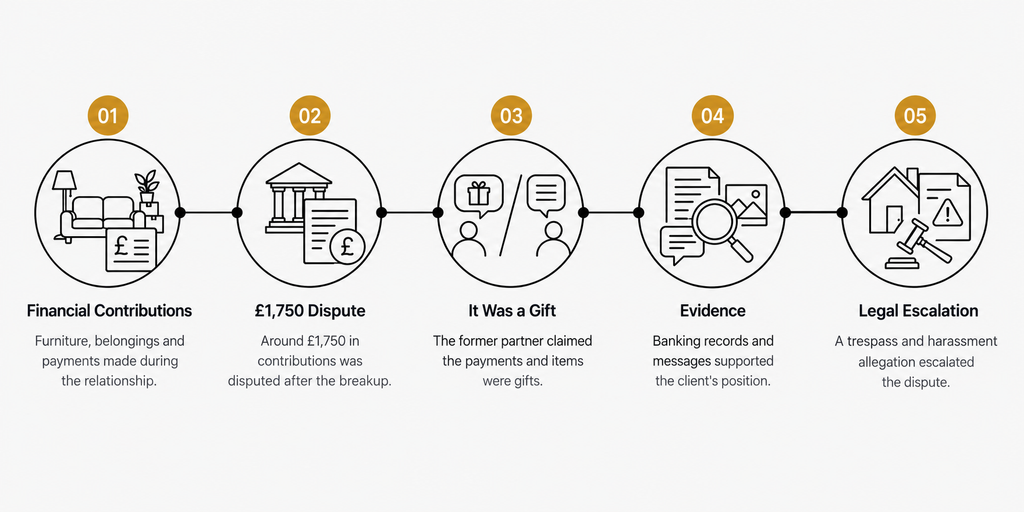
Our client had been in a long-term relationship. Over the years, he’d made several financial contributions towards his former partner’s home.
These included:
- Furniture and storage items
- A contribution towards a sofa they’d bought together
- A cash payment towards urgent boiler repairs
Altogether, this added up to roughly £1,750.
When the relationship ended, his former partner refused to return the items or repay the money. Her position was simple: it was all a gift.
Our client disagreed, and he had evidence to back that up. Banking records. Message exchanges. In some of those messages, his former partner had even acknowledged the items were his, and had offered a partial settlement figure before withdrawing it.
Then things escalated.
A letter arrived from a legal consultancy acting for the former partner. It accused our client of trespassing at her property, raised the prospect of harassment proceedings under the Protection from Harassment Act 1997, and declared the matter “closed.”
It was the kind of letter designed to make someone back off.
Understandably, our client felt the situation had grown beyond what he could handle on his own. That’s when he came to Aldwych Legal.
Understanding the Legal Issues
Two separate legal questions were running side by side here, and it was important not to let them blur together.
1. Were the payments a gift, or something he’s entitled to recover?
This is the crux of most cases involving recovering money from an ex after a breakup.
If you hand over money or buy something for a specific purpose, and there’s no clear intention to give it away for free, the law doesn’t automatically treat that as a gift just because you were in a relationship at the time.
Depending on the facts, a civil law claim like this can rest on:
- Resulting trust: where you retain a beneficial interest in something you paid for
- Unjust enrichment: where it would be unfair for the other person to keep the benefit without paying for it
- Conversion: where someone keeps or damages your property without your consent
None of these are simple “who has the receipt” questions. Whether it’s framed as an unjust enrichment claim or a straightforward debt, a civil claim against a former partner turns on intention, context, and how the communications between the parties are read.
2. Did the harassment allegation undermine his claim?
Not necessarily, but it couldn’t be ignored either. A harassment allegation civil claim situation like this needs handling with care, on both fronts at once.
Left unanswered, an allegation like trespass or harassment can shift the narrative. It can make the person pursuing a legitimate claim look like the problem.
In this case, there was a crucial fact in our client’s favour: the police had attended the incident in question and confirmed no criminal offence had been committed. That needed to be placed clearly on the record.
There was also a procedural angle. Because this was fundamentally a money claim, the Pre-Action Protocol for Debt Claims under the Civil Procedure Rules applied. That protocol sets out how a claim should be raised before court proceedings are ever considered, and getting it wrong can have real costs consequences later.
How Aldwych Legal Supported the Client
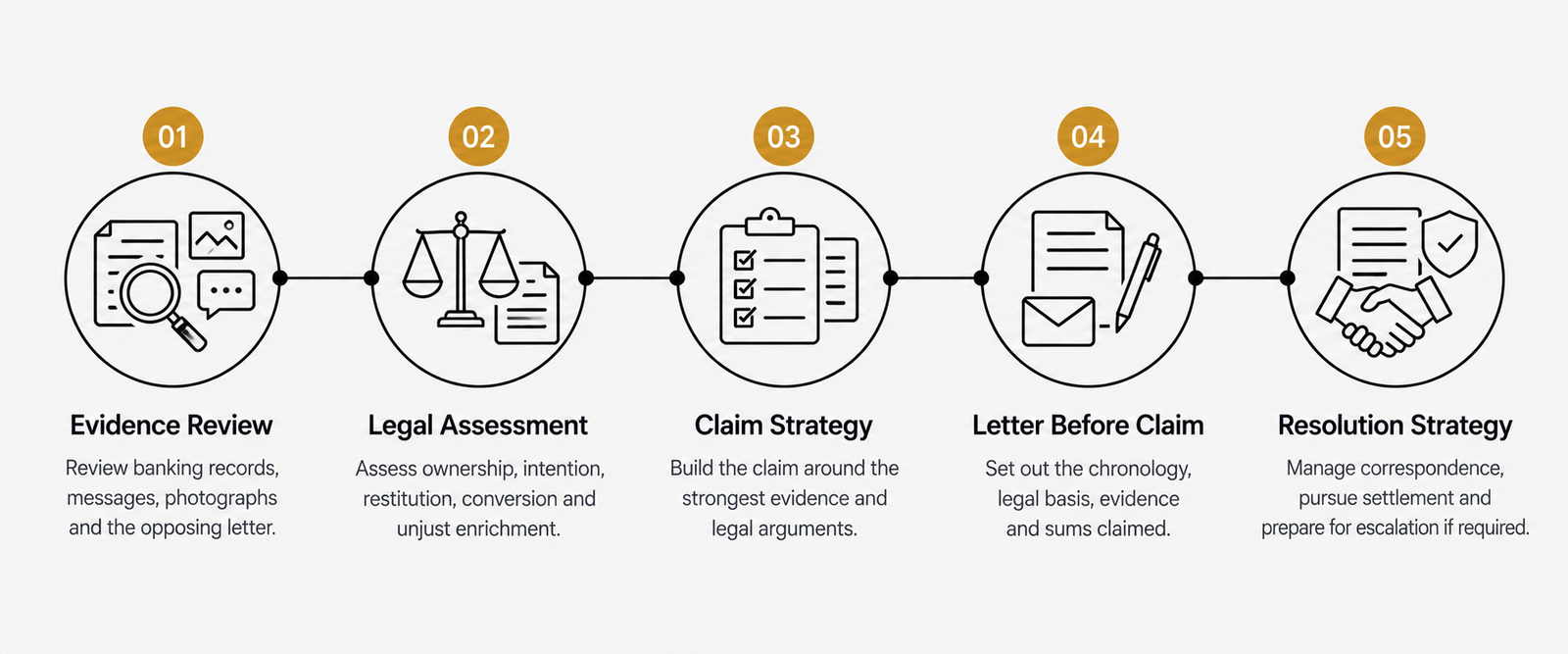
Reviewing the evidence properly, before writing a single word
Before any correspondence went out, we went through everything: banking records, message threads, photographs, the police record, and the letter from the opposing consultancy.
Each piece of evidence was assessed against the legal tests that actually mattered: ownership, intention, value, and the conduct allegations. We were honest with our client about where his position was strong, and where it needed careful handling.
Assessing the threat behind the other side’s letter
We looked closely at the letter from the opposing legal consultancy: who they were, what regulatory status they held, and how much of what they’d written was actually supported by evidence.
Our conclusion: the letter was designed to intimidate rather than reflect a genuine legal analysis of the client’s position. That shaped how we responded: firmly, but without overreacting.
Drafting a formal Letter Before Claim
This was the centrepiece of our work.
We drafted a detailed Letter Before Claim, sent to the former partner and copied to her legal representative, in line with the Civil Procedure Rules and the Pre-Action Protocol for Debt Claims.
The letter:
- Set out the full chronology of the client’s financial contributions
- Identified the legal bases for the claim: debt and restitution, conversion, unjust enrichment, and proprietary estoppel
- Referenced the supporting evidence
- Quantified the sums owed
- Addressed the trespass allegation head-on
- Gave the other side 30 days to respond substantively
It also flagged that interest would be sought under section 69 of the County Courts Act 1984, and confirmed our client remained open to mediation or another form of alternative dispute resolution.
Managing every exchange, so he didn’t have to
Throughout the pre-action stage, we took over all correspondence with the other side.
That mattered. Left to informal messages, disputes like this can spiral. A poorly worded text sent in frustration can do real damage to your position. Our client was advised on what to say, and just as importantly, what not to say.
If you’re navigating a similar dispute, this kind of structured approach is exactly what our Civil Law and Dispute Resolution services are designed for.
Our Strategy
The approach came down to two things: control the narrative, and let the evidence do the talking.
The former partner’s position, gifts, trespass, “the matter is closed,” was designed to paint our client as unreasonable and put him off pursuing what he was owed.
Fighting that with more informal messages back and forth was never going to work. What was needed was calm, evidenced, legally grounded correspondence.
We identified our client’s two strongest assets early on:
- His documentary evidence (banking records and messages)
- The police confirmation that no criminal offence had occurred
Both were placed front and centre in the Letter Before Claim. Rather than ignore the trespass allegation, we addressed it directly, using the police record as clear evidence against it.
There was also something worth noticing in the opposing consultancy’s letter: it never actually denied that the payments had been made. It only disputed what they meant.
That’s a meaningful difference, and one that becomes harder to sustain once banking records and contemporaneous messages are placed in front of a court.
The pre-action stage was designed to give the other side a genuine chance to settle, while making clear our client was prepared to take things further if needed.
Progress Achieved: Where the Case Stands Now
At the time of writing, the Letter Before Claim has been sent, and the 30-day response window is running.
Here’s where things stand:
- The former partner and her legal representative have been formally notified of the claim
- The legal basis for the claim and the supporting evidence have both been clearly set out
- Our client is no longer engaging directly with the other side
- The matter now sits on a structured, professional footing
If the other side responds constructively, this is well-positioned for a negotiated resolution.
If not, the file is ready to be referred to an appropriately authorised solicitor to consider issuing proceedings in the County Court.
It’s worth being clear here: Aldwych Legal does not conduct litigation or represent clients in court. Where matters progress to formal proceedings, we work alongside authorised solicitors and direct-access barristers who can take that next step.
Key Legal Takeaways
A few lessons from this case that apply well beyond this particular dispute:
- “It was a gift” isn’t the end of the conversation. Intention at the time of payment matters far more than what someone claims afterwards.
- Evidence wins arguments. Banking records and message exchanges can carry serious weight, especially where they show acknowledgement or an offer to settle.
- Don’t let a separate allegation derail a legitimate claim. Conduct issues and money disputes are legally distinct, even when the other side wants them to feel tangled together.
- The pre-action stage isn’t a box-ticking exercise. A properly drafted Letter Before Claim can open the door to settlement. A rushed or aggressive one can slam it shut.
- Stop engaging informally once lawyers are involved. The moment the other side brings in legal representation, your response needs to match that level.
Conclusion
Recovering money from an ex after a breakup is rarely as simple as “who paid for what.”
Whether it turns into a resulting trust money dispute or a straightforward debt claim, it involves questions of intention, beneficial interest, and how well the evidence is put together and presented. Add a conduct allegation into the mix, and the situation can feel overwhelming fast.
What this case shows is that a calm, structured, evidence-led approach can shift the entire dynamic of a dispute, often before it ever needs to go near a courtroom.
How Aldwych Legal Can Help
Aldwych Legal is a London-based legal consultancy providing non-reserved legal services to individuals and businesses across England and Wales.
We help clients with:
- Legal analysis and evidence review
- Chronology preparation
- Written legal advice
- Pre-action correspondence, including Letters Before Claim
- Negotiation support
- Preparation for escalation to authorised solicitors or direct-access barristers, where reserved legal work or court proceedings become necessary
We work on a fixed-fee basis for clearly defined pieces of work, so you know what you’re paying before we start. From the outset, we manage correspondence with the other side, so you’re never drawn into exchanges that could weaken your position.
If you’re recovering money from an ex after a breakup, or dealing with any civil dispute where you need structured legal support before proceedings are issued, get in touch.
Contact Aldwych Legal at info@aldwychlegal.com or visit www.aldwychlegal.com to arrange an initial discussion.
FAQs
1. Can I recover money I paid or spent for my former partner during a relationship?
Potentially, yes. Whether money or belongings can be recovered depends on the circumstances, including the intention behind the payment, what was agreed between the parties, and the available evidence. Banking records, messages and other contemporaneous evidence can be particularly important.
2. What if my former partner says the money or belongings were a gift?
A former partner simply describing a payment as a gift does not necessarily settle the issue. The circumstances surrounding the payment and the parties’ communications at the time can be relevant to establishing what was actually intended. Depending on the facts, a claim may involve debt, restitution, unjust enrichment, conversion or proprietary rights.
3. What evidence can help me make a claim against an ex-partner?
Useful evidence can include bank statements, payment records, messages, photographs, receipts and any written acknowledgement of ownership or repayment. In this case, the client’s banking records and message exchanges were important because they supported his account of the contributions and included an acknowledgement of ownership and an earlier settlement offer.
4. What should I do if my former partner accuses me of harassment or trespassing?
Take the allegation seriously, but do not assume that it automatically prevents you from pursuing a separate financial or property dispute. Avoid escalating direct contact and obtain appropriate legal advice. In this case, the police had attended the relevant incident and confirmed that no criminal offence had been committed, which was addressed as part of the legal response.
5. Can Aldwych Legal help before I have to go to court?
Yes. Aldwych Legal can assist with evidence review, legal analysis, chronology preparation, written advice, pre-action correspondence and Letters Before Claim, negotiation support and preparation for escalation where necessary. Aldwych Legal does not conduct litigation or represent clients in court; if proceedings become necessary, the matter can be referred to appropriately authorised solicitors or direct-access barristers.