
Some degrees can’t be finished from a lecture hall.
Nursing, midwifery, allied health, teaching these courses live and die by placement. No placement, no qualification. No qualification, no career.
So what happens when a placement collapses, and it’s not your fault?
That’s exactly what happened to one of our clients. He’d done everything right. He still ended up losing months of his degree.
Here’s how we helped him fight back and what it means if you’re facing something similar.
(Note: this matter is ongoing, so we’re sharing it as a legal insight rather than a finished case study.)
The Client’s Challenge: Doing Everything Right and Still Losing a Year
Our client was a second-year student on a professional healthcare degree in England.
His course had one non-negotiable requirement: supervised clinical placements with an NHS placement provider. Without them signed off, he couldn’t move into his final year.
He’d already passed every other second-year requirement. That’s a genuine achievement; he was also managing a diagnosed learning disability throughout.
Then his placement fell apart.
What Actually Went Wrong
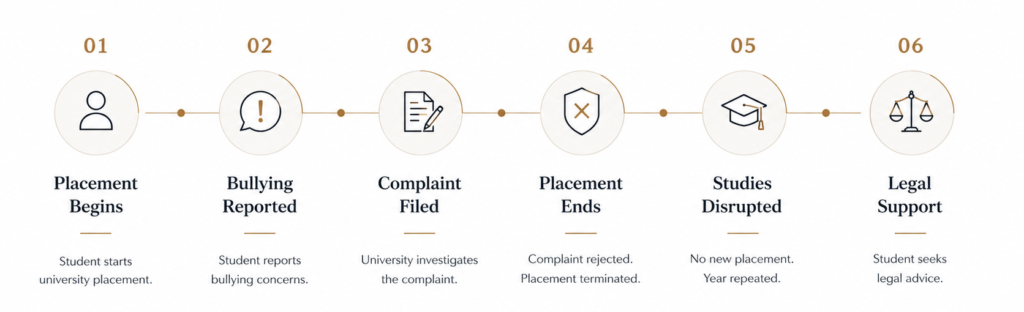
His principal mentor bullied him. Sustained, ongoing bullying that chipped away at his confidence and affected his performance.
He did what he was supposed to do. He raised a formal complaint.
He was told to put it in writing. So he did.
What happened next wasn’t support. It was a shutdown:
- The placement provider investigated internally and found “no case to answer”
- It refused to share any details of that investigation, not with him, not with the university
- It confirmed he’d get no further placement hours
- The university, despite being contractually responsible for his placements, found him nothing else
Months went by. His classmates moved into third year. He didn’t.
By the time his family reached out to Aldwych Legal, he’d been placement-less for months, forced to repeat second year, and given no real explanation by anyone.
Understanding the Legal Issues
This wasn’t a one-issue problem. Several legal threads needed untangling.
Did the University Breach Its Contract?
Here’s something a lot of students don’t realise: a university’s own rules and regulations form part of your contract with them.
That includes placement obligations.
If you’re paying tuition for a course built around a placement, and the university can’t deliver that placement or a fair alternative, that can amount to a breach of contract.
Courts ask a simple question: did the university follow its own procedures, and did it act in good faith? This is exactly the kind of dispute our Civil Law and Education Law teams deal with regularly.
Was This Disability Discrimination?
Our client had a diagnosed learning disability. That matters under the Equality Act 2010.
Three sections were directly relevant:
- Section 20: universities must make reasonable adjustments for disabled students
- Section 149: universities have a public sector equality duty
- Section 27: it’s unlawful to treat someone worse because they raised a complaint (this is called victimisation)
Here’s the part that stood out: other students who’d raised grievances were allowed to carry on with their placements. Our client wasn’t. That gap in treatment needed a proper explanation. None was ever given.
Was the Process Even Fair?
Any decision that affects your academic future has to be made fairly. You should get reasons. You should get a chance to respond.
The placement provider gave neither.
It refused to explain what it had investigated, or why it reached the conclusion it did. We challenged that on two grounds:
- Natural justice: the basic right to know the case against you
- Data protection: the right to access your own personal data under Article 15 UK GDPR and section 45 of the Data Protection Act 2018
Safeguarding Failures
Universities and placement providers both carry statutory safeguarding duties.
Failing to investigate a bullying complaint properly and failing to keep a student safe breach obligations under the Health and Social Care Act 2008 (Regulated Activities) Regulations 2014, as well as the relevant professional codes of conduct.
Why the OIA Mattered
The Office of the Independent Adjudicator for Higher Education (OIA) reviews unresolved student complaints independently of the university.
But there’s a catch: the university has to be given a chance to sort things out internally first, and it needs to issue something called a Completion of Procedures Letter before the OIA can step in.
Our client never received one. That, in itself, was a procedural failure.
We prepared and submitted a full OIA complaint on his behalf, laying out the entire history and the legal basis for his claim.
How Aldwych Legal Supported the Client
Before we say anything else, a quick but important clarification.
Aldwych Legal is a London-based Law Firm providing legal services. Where a matter requires reserved legal work, court proceedings or advocacy, we work alongside our trusted network of authorised solicitors and direct-access barristers.
Here’s what we actually did.
We Built the Full Picture First
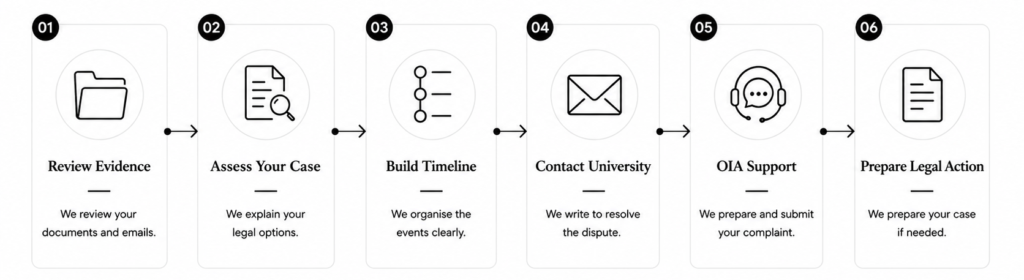
We reviewed everything: placement records, every email and letter, the bullying statement, screenshots, and the university’s own policies on placements, safeguarding, equality and complaints.
Then we built a detailed chronology a timeline mapping what happened against what should have happened procedurally.
That exercise revealed some serious gaps:
- No reasoned outcome from the placement provider’s investigation
- No interview of the student during that investigation
- The university simply not engaging with the evidence
- Clear differential treatment compared to other students
We Worked Out the Strongest Legal Angles
Breach of contract and disability discrimination stood out as the strongest claims.
We assessed the prospects of each and mapped a staged approach one that kept legal costs proportionate while keeping steady pressure on the university. That kind of staged strategy sits at the heart of effective Dispute Resolution.
We Put Both Institutions on Notice
We drafted formal pre-action correspondence to the university and the placement provider.
It set out the legal position, the specific breaches alleged, and the remedies being sought all in line with the applicable pre-action protocols.
The university’s response told its own story: it instructed a major national law firm, which acknowledged our letter and asked for more time.
The placement provider, meanwhile, kept refusing to disclose anything and confirmed there’d be no further placement hours.
We Kept the Pressure On
Throughout, we gave detailed written advice on how strong each claim was, what the options were at each stage, and how to weigh the OIA route against pre-action correspondence and civil proceedings.
At one point, the OIA raised questions and hinted it might close its review. We responded quickly, addressed its concerns, confirmed the matter’s pre-litigation status, and kept the complaint alive.
When it became clear the university wasn’t engaging properly despite having solicitors on board, we prepared a staged plan for potential civil proceedings: the right court, the causes of action, the remedies, and how the evidence would need to be converted into court-ready form.
Our client was advised that Aldwych Legal would prepare the claim documents, witness statements and supporting materials with the claim itself lodged by him directly, and any advocacy or hearings handled by separately instructed barristers.
Our Strategy: Pressure, Not Just Paperwork
Here’s the thing about legal arguments: they’re only useful if they actually change something.
Our client didn’t just want to be “right.” He wanted his placement back and his degree finished.
That meant the strategy had to build real pressure on the university, not just a strong case on paper.
We focused on three pressure points:
- Contractual responsibility. The university couldn’t just blame the placement provider and walk away; it was contractually on the hook for arranging placements.
- The discrimination angle. Treating a disabled student differently after he raised a complaint is a serious allegation. Any competent legal team advising the university would know that.
- The paper trail. A pattern of delay, non-engagement, and refusal to explain decisions doesn’t look good in front of a court or a regulator.
Running the OIA complaint and pre-action correspondence at the same time was deliberate. The OIA can’t force a university to act the way a court can, but universities take it seriously, and it kept our client’s options open. Doing both in parallel meant maximum pressure without runaway costs.
Where Things Stand Now
This matter is still active. No court proceedings have been issued, and there’s no final resolution yet.
But the progress is real:
- His legal position has been fully analysed and documented
- A detailed chronology and evidence base is ready to go
- Both the university and the placement provider have been formally put on notice
- The university instructing a major national law firm shows it’s being taken seriously
- The OIA complaint has been lodged and is being kept alive
- He’s been advised on every option available, including civil proceedings, and has confirmed he wants to proceed
Compare that to where he started: no legal record, no organised evidence, and no real understanding of the framework protecting him. That’s a significant shift.
Key Legal Takeaways
- A university’s placement obligations are part of your contract with them; failing to deliver on that can be a breach of contract
- The Equality Act 2010 protects disabled students, including the right to reasonable adjustments and protection from victimisation
- You have a legal right to access your own personal data held by a university or public body
- Decisions affecting your academic progress must be fair, reasoned, and open to challenge
- The OIA complaint and pre-action correspondence can run side by side; this builds pressure while keeping your options open
- Time matters. Academic timelines, limitation periods and the ability to preserve evidence all start ticking the moment a placement is suspended
Conclusion: Why Waiting Rarely Helps
Students on professional degrees are in a genuinely tricky spot when placements collapse.
The qualification depends on the placement. The placement depends on the institution. And institutions, especially where an body is involved, can be slow, guarded, and hard to pin down.
This case shows something important: the legal framework does offer real protection. And early, well-organised legal pressure can shift an institution’s behaviour long before anyone sets foot in a courtroom.
Sitting back and hoping the university sorts it out internally? That rarely works.
How Aldwych Legal Can Help
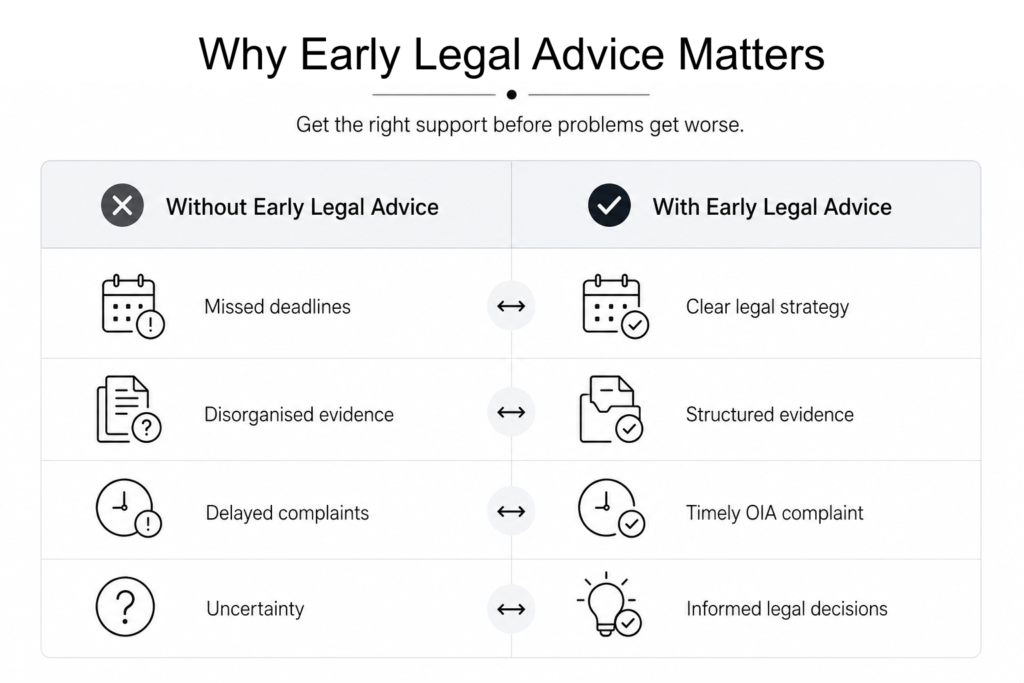
If you or someone in your family is facing a placement breakdown, denial of academic progression, or unfair treatment from a university or placement provider, get advice early.
Aldwych Legal provides legal analysis, evidence review, written advice, pre-action correspondence, complaint and appeal preparation, and dispute strategy for students and families dealing with serious problems at higher education institutions.
We’ll review everything, identify the legal framework that applies, and set out your realistic options, whether that’s an internal appeal, an OIA complaint, pre-action correspondence, or preparing for civil proceedings.
Where reserved legal work is needed, such as court proceedings or advocacy, we work alongside our trusted network of authorised solicitors and direct-access barristers, making sure the matter is thoroughly prepared before any referral. Depending on the parties involved, this kind of work often overlaps with our Professional Negligence, Commercial Litigation and Public Law teams too.
The longer you wait without a clear strategy, the harder your position becomes to recover.
Need Advice About a University Placement Dispute?
If you’re facing issues with your university or clinical placement, our team can help you understand your legal options and the next steps available to you.
Email info@aldwychlegal.com or visit www.aldwychlegal.com to discuss your situation.